Recognition Without Landmines - How to Reward People Fairly Across Union, Non-Union, Remote and Hybrid Teams
Speakers
Watch the Recording
Watch Now →About This Session
This webinar explores how to build fair and effective employee recognition programs across union, non-union, remote, and hybrid work environments. It breaks down why traditional recognition systems often fail and how they can unintentionally create bias, inconsistency, or disengagement.
Attendees learn how to design structured recognition systems that support both intrinsic motivation and measurable business outcomes. The session also covers how to align recognition with KPIs, leadership goals, and organizational culture to improve retention and performance.
Key insights include best practices for peer-to-peer recognition, avoiding common program pitfalls, and using data to track engagement and impact over time. The discussion also highlights how AI and modern tools can enhance feedback, performance reviews, and recognition workflows.
Ideal for HR leaders, managers, and people operations teams looking to modernize employee experience strategies. This session provides practical frameworks to help organizations scale recognition programs while maintaining fairness and cultural alignment.
Speakers & Hosts
Meet the people leading this session. Full bios and titles are shown below.
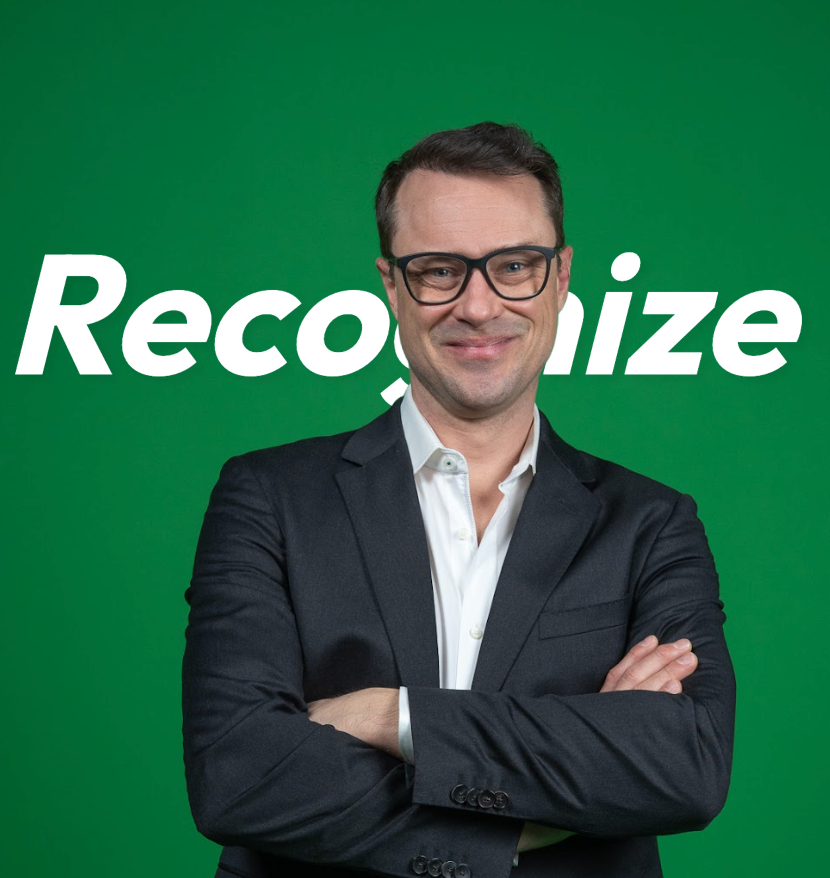
CEO and Co-Founder, Recognize
Alex Grande is a web developer with a passion for motivation and human behavior. Alex has spent over a decade engineering the "Human API", using technology to scale the fundamental psychological need for appreciation.
Transcript
Hey, everybody! We’re here for another webinar. This one’s on recognition without landmines: how to reward people fairly across union and non-union, remote, and hybrid teams.
Excited to get started. In the meantime, while we have people joining, I’m actually here in Madrid, Spain, doing a little traveling and a little remote work myself.
I actually took a picture of my home office before I left so that could be my Zoom background, which is kind of fun. But I’d love to have people put into the chat—I’d love to hear what trips you have planned this year, or maybe somewhere in the world that you’ve loved to visit and would recommend others check out. Could be right in the United States or in Canada, or somewhere else in the world.
I’ve always wanted to visit Montreal, so I should come out and meet Rue in person. That’d be really fun.
Yeah, it’d be cool to see Montreal. I hear it’s a beautiful city.
I’ve been out to Rhode Island. Rhode Island’s really cool.
Awesome.
I’ve been to San Antonio. I used to live in Austin. Great, great food in San Antonio, and amazing architecture along that river.
Awesome!
Ireland… awesome. Going to Mexico. Where in Mexico?
Be specific. Mexico’s a big country. I love Mexico. There are so many fun places, from Mexico City down to Oaxaca. I’ve spent a lot of time there. I’ve never been to Cancun though, I should check it out. I’d love to go see one of the cenotes. That’s where the big asteroid hit, right? Dinosaurs. It’d be really cool to check out the cenotes.
Guanajuato, very cool—that’s a beautiful city. I’ve always wanted to visit Guanajuato.
Lisbon, Portugal, very cool. That’s close to where I am. I thought about visiting. It’s not going to happen this trip, but hopefully another time. Ann Arbor is beautiful. I know a lot of people who love Ann Arbor.
Dubai, wow—11 months in Dubai. That must have been really interesting.
Awesome. Well, let’s get into it. We’re three minutes in, but please keep sharing where you’ve been. Disneyland—I’m sure a lot of people on this channel have been to Disneyland. I definitely have, but it’s been a couple decades at least.
Very cool. Okay, well let’s get into it.
So my name is Alex Grande. I’m the founder of Recognize, and Recognize is an employee recognition and rewards platform. We’re continuing to expand our offering.
I started Recognize because I saw the power of positivity. It’s not just about, yes, if you have a culture of recognition your employees are going to have better mental health, be more productive, and stay with your company longer. But you want to create a culture of achievement. When you celebrate wins, when you create that culture of success, then you succeed more. It becomes contagious. Winners want to work with other winners, and you’ll attract better talent in the future.
People who aren’t aligned with that winning culture will eventually move out of the company. It creates an infectious culture of success, and that’s exactly what we want to create at your company.
That’s why we’re here today.
Because recognition can backfire. It’s not always perfect. You can’t just do anything and expect it to work.
We’ve all seen issues where recognition feels unfair. Maybe you only have a yearly celebration and people feel like, “I did so many great things this year and nobody noticed.”
So it can backfire. Or sometimes recognition programs are too focused on rewards—points, gift cards, Amazon. People may try to game the system because they haven’t internalized intrinsic motivation yet.
So we often recommend starting without a rewards component. If you launch a recognition program and say there will be surprises along the way, people aren’t expecting anything, so they internalize it and build intrinsic motivation.
Recognition can also backfire if some managers are good at it and others aren’t. Some managers feel it’s a burden and don’t participate, so some teams get recognized while others don’t. That creates jealousy.
And leaders often struggle to see ROI. Some are skeptical about anything that costs money.
I once worked at a company almost two decades ago when Photoshop was the main design tool. Leadership wouldn’t pay for Photoshop, so everyone was told to use Microsoft Paint. Employees needed to get their work done, so they downloaded Photoshop illegally via BitTorrent. HR later sent an email telling everyone to delete illegal software. It was a mess.
So even when tools are needed, leadership can be hesitant.
We’ll talk about how to tie recognition to ROI and KPIs.
Before we continue, let’s do a poll. Performance reviews—what are people using today? Lattice, custom PDFs, or something else?
The trend we’re seeing is continuous feedback rather than annual reviews.
I’ve heard of “small improvements.” Custom online forms are popular. Very interesting—no one in this group is really using Lattice or similar tools, mostly custom forms.
We’ll explore that more later.
Now, traditional programs have issues. Around 75% of companies only do years of service recognition. Every year it’s the same thing.
About 50% of companies now have peer-to-peer recognition as of 2025. That’s growing from about 40% in 2016.
Only 16% of companies have goal-specific rewards programs.
A lot of managers were never trained to give feedback or recognition properly. That’s a gap.
Recognition needs structure, clear criteria, and consistency.
There are two types: specific recognition tied to actions, and pattern-based recognition that highlights trends over time.
We also need visibility. Remote employees often get less recognition.
A simple weekly scorecard can help track whether managers are giving recognition. Ideally, employees should receive 1–3 recognitions per month.
Recognition should also be public when possible, like in Slack or Teams, while still allowing private recognition when needed.
Now, building a bias-resistant program requires objective criteria, audit trails, and simple prompts.
Leadership buy-in is critical. Use the language of leadership goals and KPIs to align recognition programs.
Some employees value monetary rewards more, but motivation also includes status, access, power, and stuff.
We also talked about Asana for feedback—I haven’t seen it used that way much.
Clear criteria and structured systems are important, with approvals and audit logs.
A-B testing is powerful. Start with pilot programs before scaling company-wide.
We often see strong improvements in engagement and retention when recognition is implemented properly.
Feedback today is often ad hoc, and AI is an opportunity to improve that.
AI can help managers process feedback, summarize patterns, and prepare for one-on-ones more effectively.
Union environments require careful handling, but non-monetary recognition, swag budgets, and team recognition work well.
We also discussed cultural differences in recognition styles and remote vs in-office dynamics.
Data matters more than ever. Everything should be centralized so it can be analyzed later.
We also see regional differences in recognition preferences. Some people prefer frequent recognition; others prefer monthly or quarterly.
A good target is 70% of managers giving recognition monthly and 85% of employees receiving recognition at least quarterly.
We ended with a reminder: start small, test, iterate, and scale.
In the next 30, 60, and 90 days, you can pilot, test A-B groups, and expand across the company.
Thanks everyone for joining today.
We have another webinar coming up next week with a special guest, Ellen Butler, an expert in employee experience design.
We’re running webinars almost every week, so stay tuned and connect with us on LinkedIn.
Thanks everyone, and take care.