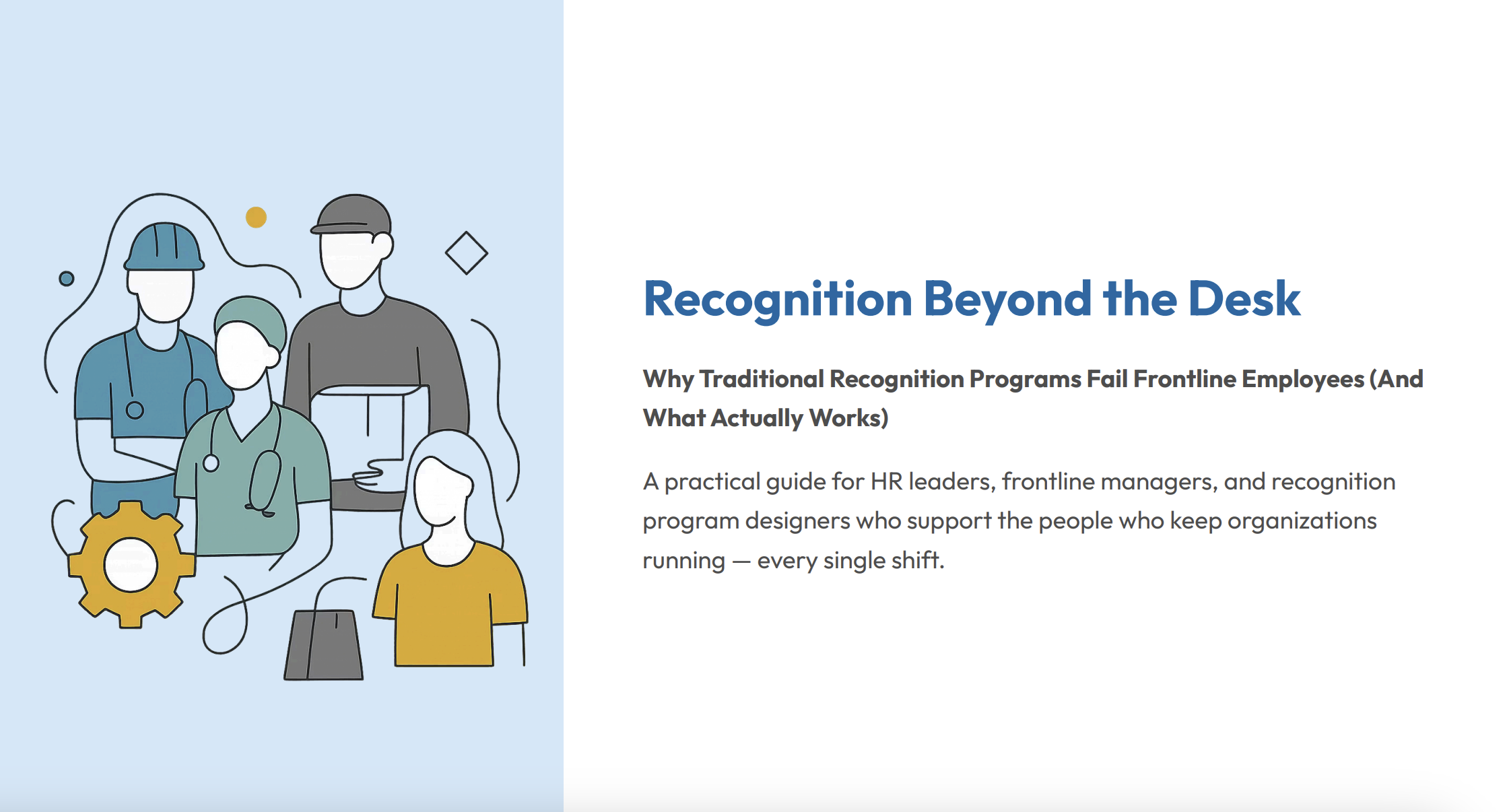
Recognition Beyond the Desk Why Traditional Recognition Programs Fail Frontline Employees (And What Actually Works)
Speakers


Watch the Recording
Watch Now →About This Session
Most employee recognition programs were built for employees who sit at a desk.
But what happens when the majority of your workforce doesn't?
In this webinar, we explore why traditional recognition programs often fall short for frontline and deskless employees in manufacturing, healthcare, retail, logistics, hospitality, and other shift-based environments. These employees are often the closest to customers and operations, yet many go unseen because recognition programs rely on communication channels they rarely use.
Join Alexia and Brittany as they discuss practical strategies for creating visibility, increasing participation, and building recognition programs that work for the reality of frontline work.
In this session, you'll learn:
✅ Why frontline employees often feel invisible in traditional recognition programs
✅ The true cost of invisible employees on engagement, retention, and culture
✅ How managers influence recognition participation and culture
✅ Ways to make recognition visible through mobile, kiosks, recognition boards, and customer stories
✅ Why recognition matters most during stressful and demanding periods
✅ How to celebrate progress, not just performance
✅ Strategies for reducing friction and making recognition easy
✅ How Challenges, Nominations, Surveys, and friendly competition drive ongoing engagement
✅ What rewards frontline employees actually value
✅ Practical ideas you can implement immediately
Whether you support employees in manufacturing, healthcare, retail, logistics, hospitality, or any deskless workforce, this webinar will provide actionable ideas to help ensure great work is recognized wherever it happens.
Learn more about Recognize: https://recognizeapp.com
#EmployeeRecognition #EmployeeEngagement #FrontlineWorkers #DesklessWorkers #WorkplaceCulture #HR #HumanResources #EmployeeExperience #RecognitionCulture #Leadership
Speakers & Hosts
Meet the people leading this session. Full bios and titles are shown below.
Head of Customer Success, Recognize
Customer Success Manager, Recognize
Transcript
WEBVTT
1
00:00:04.970 --> 00:00:06.379
Brittany Espinoza: Here we go!
2
00:00:06.950 --> 00:00:08.170
Brittany Espinoza: We're here!
3
00:00:09.340 --> 00:00:10.669
Alexia Bailey: Welcome, everybody!
4
00:00:18.220 --> 00:00:19.200
Brittany Espinoza: Alright, we got.
5
00:00:19.200 --> 00:00:21.019
Alexia Bailey: Should we go ahead and get started, or…
6
00:00:21.350 --> 00:00:29.860
Brittany Espinoza: Yeah, maybe, I see some people still trickling in, so maybe give it, like, 15 seconds, and then we'll get started.
7
00:00:30.560 --> 00:00:35.840
Brittany Espinoza: See some familiar… names here…
8
00:00:44.380 --> 00:00:50.539
Brittany Espinoza: As always, if you wouldn't mind, just pop in the chat where you're calling in from.
9
00:00:51.070 --> 00:00:54.510
Brittany Espinoza: Maybe tell us what company you're with.
10
00:00:55.090 --> 00:00:58.350
Brittany Espinoza: And let us know if it's your first webinar with us!
11
00:01:06.000 --> 00:01:07.970
Brittany Espinoza: Hey, Sarah! Hey, Patricia!
12
00:01:08.290 --> 00:01:11.439
Brittany Espinoza: We got Louisville, Austin…
13
00:01:14.150 --> 00:01:15.980
Alexia Bailey: Did I see Cairo, Egypt?
14
00:01:16.660 --> 00:01:17.230
Alexia Bailey: Wow.
15
00:01:17.230 --> 00:01:22.010
Brittany Espinoza: Honolulu… That's where we all want to be.
16
00:01:25.340 --> 00:01:35.919
Brittany Espinoza: We're going to the, Oregon coast this week. I'm actually leaving this afternoon, to the Oregon coast, and it's going to be rainy and cold, so…
17
00:01:36.210 --> 00:01:37.110
Alexia Bailey: Yeah, hey.
18
00:01:37.560 --> 00:01:39.369
Brittany Espinoza: Will not be like Honolulu.
19
00:01:40.560 --> 00:01:42.680
Brittany Espinoza: Alright, I think we're…
20
00:01:42.980 --> 00:01:48.479
Brittany Espinoza: slowed down just a little bit, people can continue to join, but let's get going. A lot to cover today.
21
00:01:48.670 --> 00:01:55.790
Alexia Bailey: Okay, great. Welcome, everybody. Today, we're going to tackle a real problem that a lot of organizations overlook.
22
00:01:56.050 --> 00:02:09.139
Alexia Bailey: And that's frontline workers. In manufacturing, healthcare, logistics, retail, they're the backbone of operations, but traditional recognition programs can completely miss them.
23
00:02:09.410 --> 00:02:20.549
Alexia Bailey: The gap is huge. While desk workers get praised in company-wide emails and awards ceremonies, frontline employees are often invisible in recognition efforts.
24
00:02:20.930 --> 00:02:36.200
Alexia Bailey: And it's about more than just being fair. It's about the same things, as all recognition programs. It's about retention, engagement, and in this case, actually acknowledging the work that keeps your business running 24-7.
25
00:02:36.510 --> 00:02:46.559
Alexia Bailey: Over the next hour, we're going to explore why standard programs fail these employees, and share some practical, proven strategies that actually work.
26
00:02:46.700 --> 00:02:57.070
Alexia Bailey: Whether you're an HR leader designing programs, a frontline manager trying to motivate your team, or someone building recognition systems, this webinar is for you.
27
00:02:57.600 --> 00:03:04.069
Alexia Bailey: The people you see on this slide here, they show up at every shift. Let's make sure they feel valued for it.
28
00:03:05.780 --> 00:03:18.160
Alexia Bailey: So, if you've been to any of our webinars before, you know we love polls. So, before we dive in, let's take a quick pulse check. Think about your own organization as you answer the poll.
29
00:03:18.700 --> 00:03:33.219
Alexia Bailey: If you're, less than 25%, deskless, you're primarily desk-bound. With some field operations, 25 to 50% would be significant frontline alongside office staff.
30
00:03:33.220 --> 00:03:45.520
Alexia Bailey: 50-75%. The majority of employees are either out in the field or on the front line, or if it's more than 75%, you're predominantly away from your desk.
31
00:03:45.990 --> 00:03:49.469
Alexia Bailey: And here's a fun fact, while we're doing the poll.
32
00:03:49.710 --> 00:04:02.960
Alexia Bailey: 80% of the global workforce does not sit at a desk, but most employee recognition programs are designed for the 20% who do. That mismatch is a major problem to address.
33
00:04:03.440 --> 00:04:08.999
Alexia Bailey: And requires a different approach. Let's see what we've got on our polls.
34
00:04:12.720 --> 00:04:15.140
Brittany Espinoza: They're pretty even split so far.
35
00:04:17.060 --> 00:04:18.390
Alexia Bailey: Interesting.
36
00:04:21.700 --> 00:04:23.910
Alexia Bailey: Are we still getting.
37
00:04:23.910 --> 00:04:27.089
Brittany Espinoza: I think we've kind of kept out. We can close her out.
38
00:04:27.900 --> 00:04:32.329
Brittany Espinoza: We got 70% participation. Good work, guys.
39
00:04:38.230 --> 00:04:41.869
Brittany Espinoza: Alright, can we see… can we see the results? Can everybody see them?
40
00:04:47.880 --> 00:05:01.960
Brittany Espinoza: There we go. Yeah, looks like a pretty even split. We've got, 26% do say that a majority are frontline workers, so… and everybody has a bit of frontline workers, so, this webinar is… is…
41
00:05:01.960 --> 00:05:10.810
Brittany Espinoza: gonna be super helpful for everybody, but yeah, I mean, 21% has over 75% of their population
42
00:05:10.900 --> 00:05:20.259
Brittany Espinoza: deskless. So, I think your… your statistic there is correct. 80% of the global workforce being deskless.
43
00:05:21.670 --> 00:05:24.709
Brittany Espinoza: I, I, I feel like this.
44
00:05:25.150 --> 00:05:39.189
Brittany Espinoza: phrase, invisible employees, is a little… is a little bit harsh. And they may not be invisible to… to us… to… to employers, but, a lot of times they can feel that way. And… and that's… that's really the problem that
45
00:05:39.190 --> 00:05:52.419
Brittany Espinoza: most recognition programs are trying to solve, but sometimes fall short. These frontline workers that are often overlooked or feel overlooked are actually creating real
46
00:05:52.700 --> 00:06:09.290
Brittany Espinoza: costs across your organization. You know, it's not just about weak culture. Yes, culture is not built in town halls, or annual celebrations. It's really built in those everyday moments between people.
47
00:06:09.290 --> 00:06:16.139
Brittany Espinoza: But the cost doesn't just come from weak culture. When these frontline employees feel burnt out.
48
00:06:18.380 --> 00:06:29.559
Brittany Espinoza: interestingly, you don't see your best performers complaining. They're actually the ones that will just quietly check out and leave. So that burnout isn't…
49
00:06:29.870 --> 00:06:32.350
Brittany Espinoza: Resulting in any positive
50
00:06:32.720 --> 00:06:46.290
Brittany Espinoza: forward movement, because those are the employees that just kind of quietly lead your organization. You're missing a lot of ideas if your frontline workers don't feel, like their work matters.
51
00:06:46.290 --> 00:06:56.360
Brittany Espinoza: The frontline workers often see things that leadership never will, but they're not going to speak up if they don't feel like they're heard.
52
00:06:56.400 --> 00:07:11.520
Brittany Espinoza: Safety is another… is another one that, we don't often think about in terms of disengaged employees. Disengaged employees tend to make more mistakes. They're more prone to, accidents and just the
53
00:07:11.530 --> 00:07:29.669
Brittany Espinoza: less attention to what they're doing, less attention and focus on what they're doing. But I think that the highest, cost of all, which is essentially a result of all of these other things, is turnover. We already know that frontline roles
54
00:07:29.670 --> 00:07:36.199
Brittany Espinoza: bleed talent at… On average, about 50% annually.
55
00:07:36.390 --> 00:07:57.099
Brittany Espinoza: And replacing somebody, typically will cost your organization 30-50% of the salary that you're replacing, and so that can add up fast. So, when you start to think about the cost of a recognition program, or the cost of
56
00:07:57.100 --> 00:08:05.379
Brittany Espinoza: making that recognition program visible and accessible to your frontline employees, you really have to think about
57
00:08:05.830 --> 00:08:21.509
Brittany Espinoza: the cost of not doing it, essentially. When your employees are feeling invisible, and… and turning over at a super high rate, it's costing you far more than any investment
58
00:08:21.510 --> 00:08:29.690
Brittany Espinoza: into your culture is… is going to cost you. So, again, it's not just about…
59
00:08:30.390 --> 00:08:34.289
Brittany Espinoza: culture and feeling good. It really is about
60
00:08:34.559 --> 00:08:43.529
Brittany Espinoza: Making people feel valued and visible, and overall, reducing the cost of burnout for your organization.
61
00:08:47.350 --> 00:08:52.080
Alexia Bailey: Like the headline says, people don't leave jobs, they leave when they feel invisible.
62
00:08:52.240 --> 00:09:06.339
Alexia Bailey: Disengagement typically follows a predictable pattern. Employees start their new job engaged, caring deeply about their work. They put in effort and commitment, they give it that 110%.
63
00:09:06.580 --> 00:09:20.330
Alexia Bailey: But over time, they stop feeling valued or noticed. That's when they check out or leave. Recognition addresses this cycle and helps to answer the fundamental human need at work. Does what I do even matter?
64
00:09:20.880 --> 00:09:33.700
Alexia Bailey: When people feel invisible, the consequences are real, just like Brittany was talking about. Higher turnover, increased absenteeism, overall disengagement. We've all heard the phrase, quiet quitting.
65
00:09:34.100 --> 00:09:45.870
Alexia Bailey: The good news is that recognition is simple and scalable. It's one of the most powerful tools we have. It directly answers that critical question, does what I do matter, with a yes.
66
00:09:46.290 --> 00:09:49.610
Alexia Bailey: And we can do it consistently across the organization.
67
00:09:49.750 --> 00:10:01.829
Alexia Bailey: And that's why recognition matters. It's not a nice-to-have, it's essential to retention and engagement. So let's walk through 5 principles of frontline recognition.
68
00:10:02.080 --> 00:10:03.880
Alexia Bailey: Principle number one.
69
00:10:04.340 --> 00:10:10.460
Alexia Bailey: Visibility creates culture. After all, how can you recognize great work if you don't even know about it?
70
00:10:10.890 --> 00:10:27.569
Alexia Bailey: There's a contrast between office versus frontline environments. In offices, the visibility is natural. It's through meetings, Slack, dashboards, and if you're in a traditional office setting, maybe you see each other in the break rooms, or you even go to lunch.
71
00:10:27.750 --> 00:10:45.820
Alexia Bailey: If you're on the floor, out in the field, at a patient's bedside, at a retail store, your work often happens in an isolation. You're by yourself, or you're with customers, or you're with patients, rather than your coworkers and managers.
72
00:10:45.920 --> 00:10:55.089
Alexia Bailey: Either way, you're away from organizational view, which means frontline workers' achievements are frequently invisible to leadership.
73
00:10:55.330 --> 00:10:57.220
Alexia Bailey: And to their peers.
74
00:10:57.640 --> 00:11:03.880
Alexia Bailey: The solution is intentional systems that surface and celebrate great work wherever it happens.
75
00:11:04.250 --> 00:11:13.990
Alexia Bailey: And it isn't just about morale, though it certainly does help with morale, but visibility drives culture by showing what the organization actually values.
76
00:11:14.080 --> 00:11:25.850
Alexia Bailey: When frontline work is celebrated and shared across the org, it reinforces priorities and inspires others by modeling through examples of the desired behaviors and traits.
77
00:11:29.130 --> 00:11:40.799
Brittany Espinoza: So, when we think about deskless employees, a lot of times, or frontline workers, a lot of times we put them in one bucket, but,
78
00:11:40.800 --> 00:11:52.240
Brittany Espinoza: depending on your industry, and your deskless population, reaching them can look different. Somebody who is,
79
00:11:52.240 --> 00:12:15.609
Brittany Espinoza: in the front line in the medical field, a nurse or, you know, that type of population, is going to have different accessibility to electronics, essentially, than somebody who maybe is a warehouse worker or a construction worker. So, we do have to think about deskless employees a little bit differently, depending on,
80
00:12:15.610 --> 00:12:36.080
Brittany Espinoza: depending on your industry and just your overall business, but there's a lot of different ways that we can reach those deskless employees, and we really need to think about how we can make that daily recognition visible to them. If the recognition… there's something to be said about public recognition. I mean, that's…
81
00:12:36.080 --> 00:12:56.679
Brittany Espinoza: A lot of the reason why we're all here running these recognition programs is to make that recognition not only easy, but also visible across the organization when people are not work… maybe they're working in different locations, or maybe they're working remotely, they're not sitting at desks all in one office.
82
00:12:56.900 --> 00:13:13.250
Brittany Espinoza: So, our goal is to make that recognition visible, but a lot of times, we do a really good job of making recognition visible to our folks that are sitting in front of a computer, but we really struggle to reach the people who need that visibility the most.
83
00:13:13.250 --> 00:13:20.090
Brittany Espinoza: Which are those deskless employees. So, again, depending on your
84
00:13:20.610 --> 00:13:45.090
Brittany Espinoza: industry. This may look a little bit different for you, but a few of the ideas that we have seen, be really effective. First one I'll talk about is kiosk mode, and for recognize, what that looks like is a live stream of the public recognitions happening in your organization, in places where your frontline employees gather. So.
85
00:13:45.090 --> 00:14:03.450
Brittany Espinoza: This might be break rooms or, just, you know, right when you walk into the office, public gathering areas, locker rooms, you know, whatever that looks like for you, where your employees gather. Having that live stream of the recognitions keeps that visibility
86
00:14:03.450 --> 00:14:15.410
Brittany Espinoza: for those employees that are not going to be frequently on a device, an electronic device, or a computer throughout the day. So you're still going to get that benefit of the visibility.
87
00:14:15.430 --> 00:14:19.090
Brittany Espinoza: For those employees that are… In the field.
88
00:14:19.380 --> 00:14:22.960
Brittany Espinoza: Mobile app is another really,
89
00:14:23.190 --> 00:14:32.659
Brittany Espinoza: solid tool if… if you don't already promote, the recognized mobile app with your employees, and you have employees who
90
00:14:32.660 --> 00:14:54.300
Brittany Espinoza: are going to have access to either their personal phone or work phone throughout the day. It's a really… it's a missed opportunity for that engagement. When recognition is right on their phone, it feels, immediate, and it feels personal, and it really reduces that… that visibility friction.
91
00:14:57.350 --> 00:15:06.889
Brittany Espinoza: Shift huddles. This is where we really rely on our managers and our leaders to help make, recognition visible.
92
00:15:07.370 --> 00:15:29.839
Brittany Espinoza: most of the time, we're already doing it. We're already doing quick little shift meetings, or, you know, end of shift huddles, things like that. We're already doing little gatherings. If we can really rely on our managers to spend 2 minutes at the start, or end of every shift to publicly acknowledge, somebody's contribution, no
93
00:15:30.000 --> 00:15:37.049
Brittany Espinoza: Electronics needed. This is just about managers helping to increase that recognition.
94
00:15:37.300 --> 00:15:57.949
Brittany Espinoza: Recognition boards. This is… I called it recognition boards, but, it's really an idea that I wanted to share, actually, that one of our… one of our customers does, that I just think was a really amazing idea to share. If you… if you don't already know, with the recognitions.
95
00:15:58.140 --> 00:16:09.649
Brittany Espinoza: on the stream page, you can print physical certificates, from any recognition, in Recognize, and something that one of
96
00:16:09.650 --> 00:16:12.909
Brittany Espinoza: Our customers, your peers, does.
97
00:16:12.910 --> 00:16:35.450
Brittany Espinoza: for their frontline workforce is they have a bulletin board, in the hallway on the way to their break room, and they will pick out a handful of their most meaningful recognitions every month, and they will print out physical certificates, and they will pin them on this bulletin board, and they'll sit there for the month.
98
00:16:35.450 --> 00:16:59.650
Brittany Espinoza: And then the next month, when they're ready to refresh, they will send those physical certificates home with the recipients. So, again, a non-electronic way to keep those recognitions visible, and then also add that extra value, because they have something tangible to bring home, that shows their contribution.
99
00:17:00.150 --> 00:17:17.489
Brittany Espinoza: So I love that idea. Another idea that, again, comes from existing, companies that are running highly effective recognition programs is, QR recognition cards. So, again.
100
00:17:17.500 --> 00:17:22.999
Brittany Espinoza: A lot of times, your managers and your leaders have better access to
101
00:17:23.569 --> 00:17:32.149
Brittany Espinoza: an electronic way to send a recognition. But unless your deskless employees are
102
00:17:32.360 --> 00:17:43.469
Brittany Espinoza: also frequently getting on an electronic to look, they may miss that you even sent them a recognition. So, I love this idea, to have
103
00:17:43.470 --> 00:18:01.079
Brittany Espinoza: QR codes printed out. I actually have a few customers that… that do this in a little bit varying ways, but, you can have a QR code, a card with a… with a QR code for each badge, or just, like, one generic one, and at… as managers send recognitions.
104
00:18:01.080 --> 00:18:24.320
Brittany Espinoza: in the platform, they will also go hand that employee that they recognized a card, which the employee can then easily scan and take them to their recognition page, where they can see the recognition that they received. So it's just that extra alert, like, hey, I sent you a recognition, to drive that… that traffic and that
105
00:18:24.320 --> 00:18:32.020
Brittany Espinoza: that employee into the platform, whereas otherwise they might not have seen it for a couple weeks, who knows?
106
00:18:32.380 --> 00:18:38.269
Brittany Espinoza: Another option for your employees who are…
107
00:18:39.120 --> 00:18:51.729
Brittany Espinoza: not able to be on a mobile phone, or like a… or like a personal device, very frequently is shared recognition stations. So, setting up
108
00:18:51.730 --> 00:19:14.900
Brittany Espinoza: stations throughout, you know, the warehouse or whatever the environment is for employees to be able to quickly send recognitions to their peers or managers to their direct reports without having to get on their personal devices. I've had a lot of customers express that they don't… they… because of, like.
109
00:19:14.990 --> 00:19:31.809
Brittany Espinoza: safety, they don't allow their employees to be just pulling out their mobile phones throughout their shift. So, you know, the mobile app may be helpful when they're not on shift, but when we're wanting that recognition to be
110
00:19:31.810 --> 00:19:43.879
Brittany Espinoza: timely, and to be happening kind of, like, during the shift, it's not really feasible if… if they can't really be pulling out their phones. So these recognition stations, you can set up tablets,
111
00:19:44.050 --> 00:20:02.569
Brittany Espinoza: in a little kiosk where employees can easily just go, couple clicks, send a recognition, and then get back to work. And then you can pair that with the kiosk mode to have a live stream of the recognitions that are being sent, showing up so people can
112
00:20:02.570 --> 00:20:08.390
Brittany Espinoza: easily recognize their peers or direct reports, but then also get that visibility.
113
00:20:08.960 --> 00:20:14.750
Brittany Espinoza: So those are a couple ideas. Again, recognition should live where employees work.
114
00:20:14.750 --> 00:20:30.629
Brittany Espinoza: So, it may look different for, for your organization, but one of these ideas, or a combination of these ideas, can really help just increase that overall visibility. And when recognition is, visible.
115
00:20:30.630 --> 00:20:33.040
Brittany Espinoza: It, it multiplies.
116
00:20:36.220 --> 00:20:40.380
Alexia Bailey: Principle number two, managers create consistency.
117
00:20:41.000 --> 00:20:55.700
Alexia Bailey: We all know about the outsized influence managers have on their teams, so this shouldn't surprise anyone. The 70% figure comes from Gallup Research, showing that roughly 70% of the difference in employee engagement
118
00:20:55.700 --> 00:21:03.520
Alexia Bailey: It's not HR programs, it's not company policies, it's direct manager behavior that drives that engagement.
119
00:21:03.640 --> 00:21:18.739
Alexia Bailey: And that, the data also tells us that when managers recognize employees, those employees are twice as likely to recognize their peers. Recognition creates a ripple effect, or as I like to call it, a virtual cycle.
120
00:21:22.230 --> 00:21:40.429
Brittany Espinoza: Yeah, and again, recognition doesn't need to be formal or elaborate. It's… it's about building consistent habits to… that will slowly reshape your team's culture. Weekly recognition, we've talked about this before, this is… this is your anchor habit.
121
00:21:40.610 --> 00:21:45.080
Brittany Espinoza: Setting a calendar reminder will…
122
00:21:45.830 --> 00:22:04.209
Brittany Espinoza: create that habit. Eventually, you won't even look at the reminder, because you'll just know that that's happening, but that's your first step. Set a weekly reminder, have your manager set a weekly reminder. One genuine recognition per manager per week will make a huge difference. Again.
123
00:22:04.590 --> 00:22:19.150
Brittany Espinoza: when a manager recognizes a direct report, that direct report is two times as likely to go send their own recognition. So it's a multiplier. And honestly, the simple practice of,
124
00:22:19.150 --> 00:22:32.260
Brittany Espinoza: expecting your managers to send one meaningful recognition per week, that will transform your team culture within 90 days. It really isn't about quantity, it's about
125
00:22:32.890 --> 00:22:37.139
Brittany Espinoza: it happening on a regular basis. It's about regularity.
126
00:22:38.070 --> 00:23:02.790
Brittany Espinoza: moving beyond the generic, great job, it is also really important. It's important to be precise about what you're recognizing. So, instead of a vague praise, you want to really make sure that you are giving specific details in the recognition. So, an example would be.
127
00:23:02.790 --> 00:23:09.589
Brittany Espinoza: You handled that difficult customer with patience and professionalism. Specific… specificity?
128
00:23:09.590 --> 00:23:12.230
Brittany Espinoza: Spec… specificity
129
00:23:12.230 --> 00:23:28.679
Brittany Espinoza: makes recognition stick in people's minds. And again, when we are talking about visibility, we're talking about public recognition. Don't keep it private. Share the wins openly. Again, team huddles.
130
00:23:28.680 --> 00:23:53.380
Brittany Espinoza: onboards, kiosk modes in your communication apps. When the whole team can see what's being recognized, it sends a signal about what behaviors and values, are actually valued, and what matter to… to managers and to the company. Consistency, this… this is critical. Recognition that only happens during
131
00:23:53.380 --> 00:23:58.430
Brittany Espinoza: like, annual reviews, it's kind of like too little, too late. You need to weave it in.
132
00:23:58.430 --> 00:23:58.770
Alexia Bailey: into.
133
00:23:58.770 --> 00:24:21.889
Brittany Espinoza: rhythm of daily work. And really, managers need to be making this part of how they operate every week. We've talked about the manager involvement before, we talk about it often, and the reason that we talk about it often is because it can be the single biggest driver of engagement in your organization. Again, I'm going to say it, I think it's probably a third time, because I think Alexia said it too.
134
00:24:21.890 --> 00:24:25.890
Brittany Espinoza: When a manager sends a recognition to their direct report.
135
00:24:25.930 --> 00:24:39.749
Brittany Espinoza: that direct report is two times as likely to send their own recognition. So, if we can get our managers involved, we're going to see the recognition multiply, and we're going to see the culture rapidly grow.
136
00:24:44.300 --> 00:25:09.289
Brittany Espinoza: Another really good point to make is, which I don't think that we talk about or think about very often, is that recognition actually matters most during the toughest seasons. It's really easy to and natural to recognize and reward and award, when those big things happen, when things are going really
137
00:25:09.290 --> 00:25:29.490
Brittany Espinoza: well, when we're really hitting our targets, when, the spirits are really high with everybody. Those are really easy, natural moments for recognition to, to flow, but it's actually most needed during the tough times. So, think about, like, holiday rushes.
138
00:25:29.490 --> 00:25:53.769
Brittany Espinoza: Staffing shortages, peak production, where people are feeling, like, burnt out, major projects, so when you have, like, big, big projects going on, recognizing that progress. Employees really crave appreciation when they're exhausted and stretched thin, and it's almost… you can fill their cup, right? Like, these tough times.
139
00:25:53.770 --> 00:26:17.339
Brittany Espinoza: It's like, we're draining the cup every shift, and one recognition can just fill that cup right back up. So, really think about, and train, again, train your managers to, make sure that the recognition is actually even more prevalent in, in times where employees are potentially feeling the most drained.
140
00:26:21.320 --> 00:26:28.259
Brittany Espinoza: And then again, celebrate progress, not just achievements.
141
00:26:28.260 --> 00:26:45.470
Brittany Espinoza: So, there's a, the Harvard Progress Principle, it's a concept that's based on research involving, employee diary entries, and it's involving thousands of employee diary entries, and, the principle
142
00:26:45.500 --> 00:27:08.529
Brittany Espinoza: states that of all things that can boost emotions, motivation, and performance at work, the most important is making progress and meaningful work. So, the research found that employees are most engaged, productive, and satisfied when they feel that they're moving forward, even through small wins. So, surprisingly.
143
00:27:08.530 --> 00:27:18.009
Brittany Espinoza: These day-to-day moments of progress actually have a greater impact on motivation than incentives or other workplace perks.
144
00:27:18.010 --> 00:27:32.010
Brittany Espinoza: And for frontline or deskless employees, progress often goes unnoticed because it doesn't look like a major achievement, but it really matters deeply to those employees for motivation and engagement.
145
00:27:32.260 --> 00:27:41.669
Brittany Espinoza: And for employee recognition programs, the takeaway is that organizations shouldn't, only celebrate major achievements.
146
00:27:41.670 --> 00:27:59.239
Brittany Espinoza: They should be recognizing smaller milestones or signs of progress, and that can be just as powerful. So things such as completing training, earning a certificate, reaching a safety milestone, learning a new skill, mentoring a colleague.
147
00:27:59.280 --> 00:28:04.530
Brittany Espinoza: Or even just as small as sending your first recognition,
148
00:28:04.720 --> 00:28:19.050
Brittany Espinoza: again, the Harvard Progress Principle tells us that people are most motivated when they can see that they're making meaningful progress, and recognition should celebrate the progress, not just the outcomes.
149
00:28:22.430 --> 00:28:26.290
Alexia Bailey: That brings us to principle number 3, remove friction.
150
00:28:26.680 --> 00:28:30.839
Alexia Bailey: Recognition should fit seamlessly into work without interrupting it.
151
00:28:31.100 --> 00:28:42.100
Alexia Bailey: The problem? Every extra step reduces participation. Research shows that if recognition takes more than 30 seconds, managers won't use it consistently.
152
00:28:42.560 --> 00:28:51.189
Alexia Bailey: So this is especially critical in fast-paced frontline environments, where spare few… spare moments can be few and far between.
153
00:28:51.340 --> 00:28:55.200
Alexia Bailey: As you can imagine, complex HR…
154
00:28:55.330 --> 00:29:00.400
Alexia Bailey: Complex HR portals are a major barrier.
155
00:29:00.700 --> 00:29:08.649
Alexia Bailey: The solution is to design for frictionless recognition. Make it easy to access, keep it fast to complete.
156
00:29:08.740 --> 00:29:20.830
Alexia Bailey: Integrate it into the natural workflow of the day. When recognition is simple and easy, adoption increases dramatically, and it becomes a habit or even a reflex instead of a chore.
157
00:29:24.250 --> 00:29:29.279
Brittany Espinoza: And so recognition… so we talked about the visibility, and now we need to talk about
158
00:29:29.280 --> 00:29:53.080
Brittany Espinoza: the ease of recognition. Like Alexia said, if it's too many steps, they're not going to do it. So, we really need to make recognition as easy and accessible as possible. And if possible, recognition programs should be, mobile first, in order to reach those deskless employees.
159
00:29:53.080 --> 00:30:03.480
Brittany Espinoza: those not sitting at desks all day. If your program only works on computers, you're excluding the people who need it most. So,
160
00:30:03.920 --> 00:30:12.610
Brittany Espinoza: Recognition anywhere means employees can give and receive kudos from the floor, any shift.
161
00:30:12.610 --> 00:30:36.599
Brittany Espinoza: any device. So again, if that means mobile app for your workforce, great. If that means recognition kiosks with tablets, great. It has to be easy and accessible for those employees that are not sitting in front of computers every day. Rewards anywhere. Again, if you're… if you're running a program with points and rewards.
162
00:30:36.600 --> 00:30:51.810
Brittany Espinoza: it needs to be easy for them to view and cash in and redeem those rewards. It's funny because, my husband, years ago, worked for a company where
163
00:30:52.450 --> 00:31:11.880
Brittany Espinoza: Actually, I feel bad, actually, because I… I, I dog on… on this recognition program from my husband's past employer. I think I've done it on previous, but it's like my… my cautionary tale, I feel like. There were literally employees who had
164
00:31:11.880 --> 00:31:35.049
Brittany Espinoza: so… had a lot of points, and they didn't even know how to… they didn't know how many they had, they didn't know how to access it, they didn't know how to redeem it, and that… I mean, what's the point? Where you're spending money on, giving out points and allowing your employees to redeem rewards, but if they don't even see it or know how to do it, then it's not…
165
00:31:35.050 --> 00:31:38.020
Brittany Espinoza: It's not really benefiting you.
166
00:31:38.490 --> 00:31:50.849
Brittany Espinoza: Surveys get the feedback from your employees on what really works for them. Pulse feedback reaches teams where they actually are.
167
00:31:50.850 --> 00:32:02.189
Brittany Espinoza: and not buried in emails. So, when you're getting that feedback, don't just send it to an email. It should be something that they should be able to access and complete
168
00:32:02.500 --> 00:32:27.469
Brittany Espinoza: on a mobile device. Again, if that's their personal mobile device or a mobile device set up for community sharing, either way, you should be able to collect that feedback, in a very easy way. Challenges, celebrations, communication, again, this should all be happening, in a way that makes sense for your deskless employees.
169
00:32:27.470 --> 00:32:39.469
Brittany Espinoza: If it's… if you can only complete challenges or, you know, see anniversary celebrations if you're on a computer, then you're missing a large portion of your workforce.
170
00:32:39.470 --> 00:33:00.039
Brittany Espinoza: So the bottom line being, mobile or shared device accessibility, it's not just a extra or nice to have. It really is the foundation that makes the entire program actually work if you have, a large percentage of deskless employees.
171
00:33:04.990 --> 00:33:28.749
Brittany Espinoza: And this also could look different for different populations. As we saw in our poll, we don't have 100%, deskless workers. In fact, I think, it was pretty evenly split, just from our participants here. We have, some companies that have 25%, 50%, 75%,
172
00:33:28.750 --> 00:33:44.909
Brittany Espinoza: So, you have to be able to hit all different areas and, make sure that participation is easy for everyone. So that might look different for one portion of your population to another, and that…
173
00:33:44.910 --> 00:34:01.660
Brittany Espinoza: And a lot of times when it's not easy, it's the peer recognition, that you're missing. It might be easy for leaders to, or managers to send recognition, but if it's not easy for your
174
00:34:01.900 --> 00:34:20.979
Brittany Espinoza: general population, then that peer recognition, which is what caught… which is what, multiplies and what really builds your culture, and that consistency and that frequency of recognition, that's what you're gonna miss. That's gonna be, a massively underutilized
175
00:34:20.980 --> 00:34:24.359
Brittany Espinoza: part of your recognition program.
176
00:34:24.580 --> 00:34:31.869
Brittany Espinoza: But those peers that are working so closely to each other, those are actually the ones that
177
00:34:32.050 --> 00:34:50.200
Brittany Espinoza: see all the great things that are happening. A lot of times, they're seeing the great work that their peers are doing, and managers are missing it. So if we're creating friction on, for those peers to recognize each other, then you're going to see
178
00:34:50.449 --> 00:35:03.490
Brittany Espinoza: a lot of misrecognition or wins going unnoticed. So it's really important to… we've talked about the manager piece of it, but making participation easy.
179
00:35:03.710 --> 00:35:26.400
Brittany Espinoza: we're not really talking… I mean, not in all cases, but I think in a lot of cases, it is easier for the managers to do it, but it's really hard for people to recognize each other. Or we see programs where the managers are really highly engaged, but your actual, like, end users are not super engaged.
180
00:35:26.400 --> 00:35:48.629
Brittany Espinoza: you may have, an issue with how easy it is for those people to recognize each other. And again, a lot of times, they're seeing, wins and great behaviors that managers and leaders are missing, and if we don't make it easy for peers to recognize each other, then those may be going unnoticed.
181
00:35:49.920 --> 00:36:13.539
Brittany Espinoza: And that can also just be… it might not even be, like, device-related, so maybe, it's not always about, like, do they have the mobile app, or do you have recognition stations set up? Sometimes it can be just the way that your program is set up, too. So think about how you have your badges set up, and are they set up in a way where
182
00:36:13.540 --> 00:36:19.980
Brittany Espinoza: where… Peers can easily choose a badge for
183
00:36:19.980 --> 00:36:44.860
Brittany Espinoza: something that they want to recognize. That might mean, do you have enough badges that are sendable by anyone, or that have low to no point values? But also, are they titled and described correctly for what your, frontline workers would be recognizing each other for? If they're, you know, solely based on, like, manager type…
184
00:36:44.860 --> 00:37:05.869
Brittany Espinoza: behaviors that managers would recognize, then they might feel a little bit weird using them. They might not feel, if they want to recognize a behavior, but they don't really see a badge that, that matches what they want to recognize, that can also cause some friction. So, again, we've talked a lot about, like, accessibility, and visibility, but it
185
00:37:05.870 --> 00:37:19.759
Brittany Espinoza: But also think about how that program is set up for them to feel like they can easily, choose a badge and, you know, within just a couple of quick clicks, send a kudos to a coworker.
186
00:37:24.210 --> 00:37:29.199
Alexia Bailey: Principle number 4. Give employees a reason to return every day.
187
00:37:29.680 --> 00:37:44.899
Alexia Bailey: Recognition is just the starting point. We need to keep employees engaged every single day. The key to creating is creating a rhythm that makes people want to show up, not just feel obligated to do so. And there are four pillars to make this work.
188
00:37:45.030 --> 00:37:56.640
Alexia Bailey: Challenges, by far my favorite. Time-bound competitions between teams and locations. These build energy and camaraderie while keeping people motivated to participate.
189
00:37:56.930 --> 00:37:59.560
Alexia Bailey: And they're fun. That's why I like them.
190
00:37:59.750 --> 00:38:10.019
Alexia Bailey: Nominations, structured peer and manager recognition tied to your values. This type of recognition feels especially meaningful and intentional.
191
00:38:10.460 --> 00:38:27.200
Alexia Bailey: Surveys, a quick temperature check shows, employees that their voice matters, and that leadership is actually listening to feedback. Our customers who take a pulse and then act on the resulting insights demonstrate that they care in a very real way.
192
00:38:27.620 --> 00:38:38.269
Alexia Bailey: And, mobile experiences. A personalized app right there on your phone keeps recognition and rewards front and center throughout the day. Together.
193
00:38:38.810 --> 00:38:47.100
Alexia Bailey: These create touchstones that give people reasons to engage daily. It becomes part of the rhythm of work instead of an afterthought.
194
00:38:48.990 --> 00:39:08.080
Brittany Espinoza: Yeah, I really, I really like this… this pillar here. Recognition programs create the most impact when they're part of employees' regular routines and not something that they only visit once in a while. The most successful engagement programs that we have seen
195
00:39:08.150 --> 00:39:22.630
Brittany Espinoza: create multiple reasons for employees to come back throughout the week and throughout the month. So if the platform is only used for occasional recognition, you're gonna see your participation become sporadic.
196
00:39:22.710 --> 00:39:28.530
Brittany Espinoza: The more touchpoints that employees have, the more likely they are to stay engaged.
197
00:39:28.570 --> 00:39:35.240
Brittany Espinoza: And every… every interaction that they have is going to reinforce your culture, whether it's
198
00:39:35.240 --> 00:39:50.159
Brittany Espinoza: someone recognizing a peer, or completing a challenge, answering a survey, celebrating a milestone, or even just browsing rewards. They're engaging with your organization's values and your organization's community.
199
00:39:50.760 --> 00:40:03.240
Brittany Espinoza: And that frequent participation, it helps keep recognition top of mind. So then that recognition becomes a habit rather than that sporadic event.
200
00:40:03.240 --> 00:40:11.860
Brittany Espinoza: And when employees return regularly, that recognition really becomes woven into the employee experience.
201
00:40:11.860 --> 00:40:17.750
Brittany Espinoza: Instead of it just existing as a standalone product.
202
00:40:17.750 --> 00:40:42.059
Brittany Espinoza: And the more participation that there is, the more visibility there is. Employees see achievements and milestones, and positive behaviors that are happening across the organization, and that really strengthens expectation, it strengthens connection, and overall, it strengthens employees' feeling of.
203
00:40:42.060 --> 00:40:47.330
Brittany Espinoza: Of belonging to a community and belonging to a company with a strong culture.
204
00:40:47.870 --> 00:40:58.430
Brittany Espinoza: So, think of your recognition program as a destination rather than a tool. The more value your employees find.
205
00:40:58.430 --> 00:41:21.830
Brittany Espinoza: in your program, the more often they'll return, the more recognitions will be sent, and the stronger your culture, will be. So, examples of reasons to return, Alexia talked about, four super strong reasons. Obviously, your peer-to-peer recognition, automated service anniversaries and birthdays, those are those,
206
00:41:21.830 --> 00:41:24.150
Brittany Espinoza: automated, you know.
207
00:41:24.150 --> 00:41:33.519
Brittany Espinoza: Admins don't have to worry about. These are just gonna happen, naturally. Challenges or engagement campaigns.
208
00:41:33.520 --> 00:41:57.029
Brittany Espinoza: So… so using those built-in recognition moments throughout the year, whether it be, holidays or celebrations, or just company-type milestones, those are those natural moments that we can weave into our… into our, recognition program with engagement campaigns, surveys and feedback opportunities.
209
00:41:57.080 --> 00:42:20.479
Brittany Espinoza: Company announcements, again, if they know that they're going to learn about what's going on in the company, by going to their recognition program, and they see those announcements happening right there on the stream page, you're creating a destination rather than just a recognition program, and you're gonna see your engagement, really,
210
00:42:21.680 --> 00:42:29.030
Brittany Espinoza: Exponentially increase if that becomes a destination for them, rather than a standalone program.
211
00:42:29.250 --> 00:42:42.509
Brittany Espinoza: Nominations, rewards, leaderboards, and again, new badge launches, keeping things fresh, keeping things fun, keeping things exciting.
212
00:42:42.640 --> 00:43:07.199
Brittany Espinoza: what we have seen is that organizations with the strongest cultures don't rely on a single avenue for recognition. They create consistent opportunities for employees to participate, and connect and contribute throughout the year. So every reason that we give them to return is another opportunity to strengthen culture.
213
00:43:08.040 --> 00:43:18.059
Brittany Espinoza: And the friendly competition really, creates energy in the tool. It transforms those routine metrics
214
00:43:18.060 --> 00:43:42.519
Brittany Espinoza: into goals that people will actually care about. So structure competitions at different levels. So, you know, depending on how… what would make sense for your organization, doing department-level competitions or location by, or competition by location, or even by shift, because that gives everyone a chance to participate.
215
00:43:42.520 --> 00:43:50.530
Brittany Espinoza: If you are an organization where, there's different shift work, a lot of times those shifts that aren't
216
00:43:50.530 --> 00:44:06.710
Brittany Espinoza: during the same hours that, like, leadership is working, those are the… those are your employees who tend to feel like they're not a part of the culture, or their efforts aren't seen. So this is something that can really help make sure that everybody is… is involved.
217
00:44:06.710 --> 00:44:26.509
Brittany Espinoza: And the prizes don't have to be, expensive, they just need to be meaningful, so things like maybe a pizza party for the winning shift, or, my favorite is, like, a traveling trophy that, you know, can be displayed if you're doing, like, location by location. That's always a fun, a fun thing to do.
218
00:44:26.620 --> 00:44:38.830
Brittany Espinoza: But remember, the prize really isn't the real motivator, it's… it's the story of how the team earned it together, and… and it's, again, building that community and that culture.
219
00:44:42.430 --> 00:44:57.789
Alexia Bailey: And last but not least, principle number 5, reward what employees actually value. The most well-designed recognition problem… oh my goodness. The most well-designed recognition program
220
00:44:58.150 --> 00:45:09.439
Alexia Bailey: fails if the rewards don't resonate with your employees. Frontline workers may have different needs than desk workers, so it's important to understand who you're rewarding and what will motivate them.
221
00:45:09.610 --> 00:45:22.620
Alexia Bailey: For company swag, it really is worth investing in quality items that people will actually want to wear, and to use, and to show off where they work. Not cheap promotional junk that sends a different message.
222
00:45:23.050 --> 00:45:37.550
Alexia Bailey: Everyday gift cards, like groceries and gas, those can help with real weekly expenses that matter to frontline workers. Amazon Rewards, this is very good timing. It is Amazon Prime Day, if you did not know this.
223
00:45:37.550 --> 00:45:38.240
Brittany Espinoza: True.
224
00:45:38.240 --> 00:45:43.309
Alexia Bailey: That gives opportunities, for choice and flexibility to pick what you actually need.
225
00:45:43.760 --> 00:45:46.269
Alexia Bailey: And it doesn't always have to be stuff.
226
00:45:46.380 --> 00:45:51.709
Alexia Bailey: Flexibility perks, things like the best parking spots.
227
00:45:51.870 --> 00:45:57.520
Alexia Bailey: Being able to leave early on a Friday. Schedule adjustments can often mean more than a gift card.
228
00:45:57.670 --> 00:46:08.030
Alexia Bailey: Family experiences, also. Tickets, outings can create lasting memories and show that you value their whole life, not just the work.
229
00:46:08.920 --> 00:46:15.760
Alexia Bailey: So convenience and thoughtfulness often outweigh the dollar amount. It's more about timing and relevance.
230
00:46:20.440 --> 00:46:23.230
Brittany Espinoza: Yeah, and again, the…
231
00:46:23.410 --> 00:46:33.310
Brittany Espinoza: the key here is people retain stories far better than, abstract points or generic praise. So,
232
00:46:33.870 --> 00:46:36.689
Brittany Espinoza: Really making sure that
233
00:46:36.830 --> 00:46:50.580
Brittany Espinoza: the recognition is meaningful and, and not generic. So, you know, again, a forgettable recognition might be something like, oh, hey, great job this week, but
234
00:46:50.580 --> 00:47:09.230
Brittany Espinoza: you know, that's not really something that's connecting to the specific person, or something that they did, or the specific outcome. And it doesn't really make them feel truly seen or valued for what they actually did. You know, so instead, doing something that is
235
00:47:09.890 --> 00:47:22.539
Brittany Espinoza: specific, for ex… for example, staying late to train a new team member, you're gonna have a clear impact, like hitting a production goal, or
236
00:47:22.540 --> 00:47:39.760
Brittany Espinoza: you know, avoiding a delay affecting 200 orders, or something like that. It connects to something bigger, something that demonstrates, leadership and that strengthens the team. And this sticks because it's concrete and meaningful.
237
00:47:39.760 --> 00:47:46.170
Brittany Espinoza: And once again, when you share specific recognition stories in team huddles or on boards.
238
00:47:46.170 --> 00:47:59.600
Brittany Espinoza: Others see exactly what excellence looks like. It creates inspiration and motivation for the whole team to replicate that behavior. Stories are contagious. They spread more…
239
00:47:59.600 --> 00:48:06.770
Brittany Espinoza: More effectively than, having, like, policies or generic expectations.
240
00:48:09.200 --> 00:48:13.370
Brittany Espinoza: So, to wrap things up,
241
00:48:13.530 --> 00:48:33.559
Brittany Espinoza: let's review the 5 things that you can do starting tomorrow to, transform recognition culture immediately. No new tools, no extra budget or lengthy rollout needed. These are 5 simple things, that you can do starting today, or tomorrow.
242
00:48:33.720 --> 00:48:51.140
Brittany Espinoza: Shift meetings, again, these are things that are already happening. Use those first 60, have your managers use those first 60 to 90 seconds in huddles to highlight one or two specific wins from the previous shift. This will set a positive tone.
243
00:48:51.140 --> 00:49:02.789
Brittany Espinoza: And it will help make that recognition visible to the whole team. Manager accountability. We've talked about this a lot. Ask managers to give one specific recognition per week.
244
00:49:02.870 --> 00:49:09.699
Brittany Espinoza: Track it, celebrate the managers who do it, and also make sure leadership models this behavior as well.
245
00:49:10.050 --> 00:49:28.400
Brittany Espinoza: Physical visibility. Whether for your organization, that means a public recognition board with the printed certificates, a smart TV with a live stream of, of recognitions happening with kiosk mode, QR code cards.
246
00:49:28.400 --> 00:49:42.049
Brittany Espinoza: You know, make that visibility, however it works for your organization. Break room, locker room, entrance, make recognition visible and easy.
247
00:49:42.190 --> 00:50:01.469
Brittany Espinoza: Fourth, engagement hooks go beyond just sending recognition. Give employees a reason to, make your recognition program a destination. Challenges, dominations, campaigns, surveys, give people more reasons to participate. And five.
248
00:50:02.050 --> 00:50:17.119
Brittany Espinoza: Co-create with your frontline workers. Don't assume what employees want. Ask them directly what recognition means to them, what rewards actually matter to them, and most importantly.
249
00:50:17.460 --> 00:50:35.959
Brittany Espinoza: ask them what's blocking their participation. You know, we can assume and we can share what we have heard from other organizations, but the best approach is to ask your deskless employees what is blocking their participation, and that's going to give you the easiest
250
00:50:35.960 --> 00:50:48.439
Brittany Espinoza: path forward to increasing engagement. These aren't theoretical, these are actionable items that you can start immediately. The goal is momentum.
251
00:50:48.440 --> 00:50:57.419
Brittany Espinoza: and culture shift, not perfection. So, these aren't things that have to be perfect when you start them, these are just things that we need to start.
252
00:50:58.040 --> 00:51:03.540
Brittany Espinoza: With that, we have about 9 minutes left.
253
00:51:03.600 --> 00:51:27.329
Brittany Espinoza: I want to make sure that we have time to answer some questions, if anybody has some, or if you have some ideas on how you have been successful engaging your frontline workforce that maybe we didn't mention, that would also be wonderful to hear in the chat. So, if anybody has any feedback, or ideas, or questions,
254
00:51:27.460 --> 00:51:34.720
Brittany Espinoza: Or wants to see anything in action, go ahead and pop that in the chat, and we'll just wait a couple minutes and see what we have.
255
00:51:38.110 --> 00:51:41.180
Brittany Espinoza: I'm gonna check the Q&A. Do we have anything in Q&A?
256
00:51:43.870 --> 00:51:49.780
Brittany Espinoza: I see no questions in Q&A. Anybody in the chat have… have anything?
257
00:51:56.110 --> 00:52:00.219
Brittany Espinoza: We covered a lot, so it's a lot to sink in.
258
00:52:01.630 --> 00:52:19.389
Brittany Espinoza: If those questions start flowing after the fact, please feel free to reach out to myself or, Alexia. I know we talk to a lot of you frequently. Of course, you can also reach out to support at RecognizeApp
259
00:52:19.390 --> 00:52:26.280
Brittany Espinoza: And, yes, Natasha, we will send out both the recording
260
00:52:26.280 --> 00:52:43.160
Brittany Espinoza: of the presentation, as well as the slide deck with all the useful information. So we will get that out to you guys later today. And again, if the questions come to mind after the fact, please do not hesitate to reach out to us.
261
00:52:44.720 --> 00:52:47.429
Brittany Espinoza: Otherwise, everybody have a wonderful rest of your day!
262
00:52:47.820 --> 00:52:50.849
Brittany Espinoza: And thank you so much for joining us. We'll see you in the next one.
Resources
Related Sessions
Jan 29, 2026