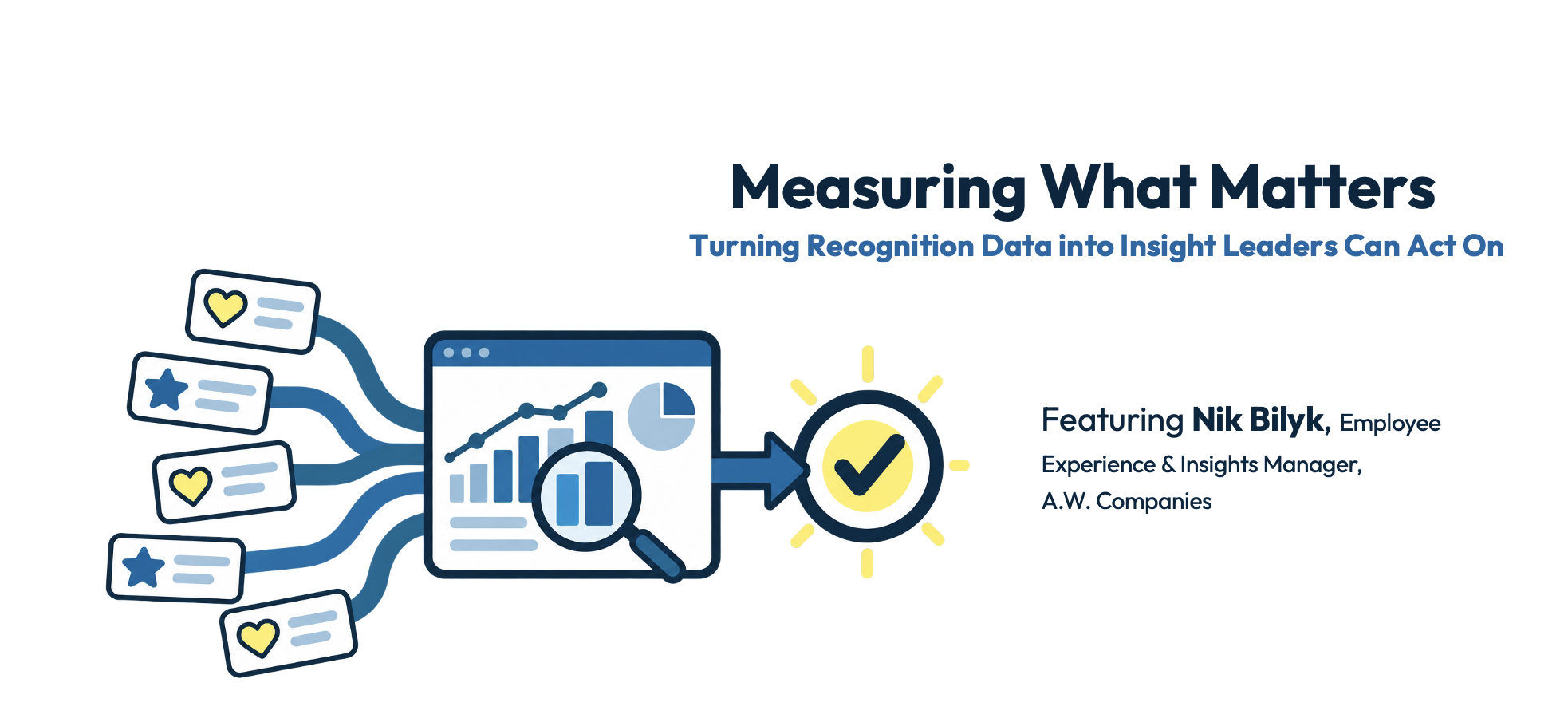
📊 Measuring What Matters: Turning Recognition Data into Insight Leaders Can Act On
Speakers




Watch the Recording
Watch Now →About This Session
Learn what to actually do with your recognition data, from tracking the right KPIs to spotting gaps in team and leader engagement. Special guest Nik Bilyk (A.W. Companies) shares how his team trains leaders and ties recognition to business strategy.
By the end of this webinar, attendees will be able to:
✅ Apply a step-by-step framework for measuring recognition program success, from adoption through business outcomes.
✅ Explain the core KPIs and what each one actually tells you.
✅ Use manager- and team-level data to spot which leaders are (and aren't) driving engagement, and where gaps exist across teams.
✅ Connect recognition data to business goals and strategy — and see a real-world example of how one organization trains its leaders to do this.
✅ Build a simple baseline, target, and review cadence for the KPIs that matter most to your organization.
★ Guest Speaker:
Nik Bilyk, Employee Experience & Insights Manager at A.W. Companies, will share how his team trains frontline leaders on recognition best practices and connects program participation to broader people and business goals.
Speakers & Hosts
Meet the people leading this session. Full bios and titles are shown below.
Head of Customer Success, Recognize
Customer Success Manager, Recognize
Customer Success Manager, Recognize
Employee Experience & Insights Manager, A.W. Companies
A.W. Companies is a talent and outsourcing partner specializing in staffing, recruiting, and contact center operations. Nik will share how A.W. Companies connects recognition to business priorities, trains leaders on meaningful recognition, and builds Recognize into the employee experience.
Transcript
Measuring What Matters: Turning Recognition Data into Insight Leaders Can Act On
Lightly edited transcript. Timestamps mark the beginning of each passage; filler, repeated words, and caption formatting have been cleaned.
Speakers: Brittany Espinoza, Samantha Liravongsa (Sam), Alexia Bailey, and Nik Bilyk.
[0:15] Brittany: Okay, looks like we've got some people joining. We've got about 1 minute till we start. We will start right at 11 on the dot.
[0:37] Sam: Hello, everyone! Good to see some familiar faces. For those of you who have not joined before, would love to know where you're calling in from. If you're rooting for anybody, football season has officially started. The Packers have let me down already in the first two games.
[1:00] Brittany: I don't know football. But I'll put where I'm calling in, or where I'm joining from. Hey, Sarah.
[1:29] Sam: Fall is here, too. Officially, yesterday was fall. I'm very excited.
[1:36] Brittany: Yeah, Alexia, rain starts here, too, about 5 hours, but just in time for my son's football game. So, that should be fun.
[1:44] Sam: Oh, Nick, are you the bearest?
[1:46] Nik: Yes, I am.
[1:47] Sam: Oh, we're rivals! So I'm sure you're happy about how we're starting off the season.
[1:51] Nik: Well, week one was fantastic, but week two was did not go how I hoped.
[1:59] Brittany: Okay, so we have a lot of content to cover today, so, I want to go ahead and get things started as people continue to kind of trickle in. So first, obviously, welcome everybody. We really want to thank you guys for joining us for today's session. If you if I have not met you before, I am, Brittany, Head of Customer Success with Recognize, and I have here with me, my customer success managers, Sam and Alexia. And in today's session, we are going to center around measuring what matters. and then turning that recognition data into an insight that leaders can actually act on. So, I think most organizations are already looking at their recognition data, but the harder part is really knowing what to do with it. So, for example, a higher recognition count, so a high volume of recognitions being sent, can look really encouraging, but that number alone isn't going to tell us whether recognition is reaching the right people or the right groups, whether managers are consistently participating, or whether the program really is supporting the outcomes that your organization cares about. So, today we're going to move from activity to interpretation, and then we're going to put that into action. And we're also joined by Nick Bilyk from AW Companies. We are thrilled to have Nick here with us today. He is going to share with us how his team connects Recognition to leader training, employee experience, and business priorities.
[3:43] Brittany: So let's begin with, what I hope you will all be able to take away from today's session. So, by the end of this webinar, I really want you to feel comfortable and confident doing 5 things. First, defining what success means for your own recognition program, and that might be different between organization and organization. Or program stage, as well. Second, identifying the adoption, engagement, reach, and quality measures that can tell you whether the program supports, each definition. Third, I want you to be able to find gaps that disappear inside company-wide averages. Fourth, we're going to be connecting recognition patterns to employee sentiment and business goals. And then finally, we're going to be building a simple review rhythm that leaders can actually use. We will share a framework, but the goal really is not to hand you a long checklist. The goal is to help you choose the few measures that answer your most important questions as an organization. and really get you started. One of the reasons that I chose to do this topic, as we close out, quarter three and enter into Quarter 4 is that quarter four, number one, is a time where most of us are already reviewing our program metrics, and we really want to show you, as you're reviewing those program metrics. What those insights tell you, and what you can do with those insights.
[5:23] Brittany: to plan for your program objectives for 2027. The other reason is that December is a or, I'm sorry, not December included, Q4 is a really good time to test out some initiatives to help move the needle on some of the objectives that mean the most to you. It's a it's a great time of people feeling gratitude and feeling of giving, and it's just a really great time to be able to, make some quick changes to see what can move the needle and incorporate that into your planning for your 2027 program. So, a quick a couple quick housekeeping notes. If you joined after the little announcement, we are recording. If you have questions throughout the webinar, you can submit them through the Q&A panel, or feel free to pop them in the chat. We will, potentially answer them, as we flow through, and we'll, of course, check all the questions at the end and hopefully have time to answer those. At the end of the webinar. And then we will also be sharing the recording, the slides, and a playbook resource with you guys as well. So that'll be shared with you after the webinar. So I'm going to turn it over to Sam, who can start with, the most common measurement trap, which would be treating volume as the outcome.
[6:53] Sam: Thank you, Brittany. So Super thrilled to have everyone here today, and we're gonna go ahead and jump right into that fundamental shift in how we think about recognition metrics. So as many organizations look at these thousands of scent recognitions, they just automatically assume that your culture is thriving, right? But the truth is, recognition volume is an activity metric, not a success metric. And as Brittany mentioned. High volume can be deceiving. So, thousands of recognitions can easily be driven by a tiny, vocal fraction of your workforce. While the vast majority may still feel completely invisible. So a truly successful program goes beyond vanity numbers. strengthening your culture, reinforcing core behaviors, elevates the overall employee experience and directly supports strategic business goals. So before celebrating total numbers, we have to ask, who is actually giving and receiving the recognition? Now that we understand why volume alone does not tell the whole story, let's, let's look into how do we build a strategy that actually tracks real cultural impact? And to help navigate this, we developed our 12-step measurement framework. So it's built into four simple, logical phases. So phase one, define. This is where you can start pinning down what success actually looks like for your organization.
[8:24] Sam: And what does success mean to you? And then we have phase two, measure. So shift your focus to program adoption, core KPIs, engagement reach, and Recognition quality. Phase 3, understand. Now, this is where you want to connect platform metrics to real employee sentiment, the supporting data, and your business outcomes. And then lastly, Phase 4, Act. This is where you're going to establish that baseline target and create reoccurring review processes that keep leadership accountable. So today, we are focusing on the critical foundations driving, defining success, driving adoption, and mastering your core KPIs. With this framework as your guide, our very first milestone, Is gonna be step one, defining what success means for your business. So every business has different priorities. common objectives include boosting engagement, improving retention, strengthening culture. Instead of trying to measure every single chart in your dashboard, think about the top 3 outcomes that really matter the most to your team and your executive leadership team right now. So when you align your measurement strategy to clear business outcomes, your data tells a compelling story, and that's going to get your leadership on board immediately. So once you have oops, sorry, once you have locked in, I think we have a poll coming up, right, Brittany? My apologies. So rewind. We have a poll, I do just want to get your guys' insight here, and I would love to know what are the three most important outcomes for your program?
[10:14] Sam: We'll do this for about a minute.
[10:21] Brittany: And it might be hard to choose 3, because, as I look at these for our own internal recognition program, I can see value in every single one of these objectives, but, really kind of focusing on what the most important objectives are can really help you define a clear path forward, rather than feeling like you're, kind of shooting for too many stars. And they're also not set in stone, right? So if, the if one objective feels like it's really, meeting the mark as you look at your metrics, maybe next quarter or next year, that objective, shifts a little bit or, evolves. I think we got pretty much everybody answered.
[11:28] Sam: So it looks like, increased engagement or morale. Increase Recognition Consistency, and strengthen culture and alignment to values. Awesome. Perfect. All right, thank you, everybody, for getting those answers in there for you. So, as that framework, as your guide, let's think about your very first milestone. So, like I said, every organization has different priorities, so common, objectives, again, boosting engagement, it looks like, strengthening culture, core values. So, what I want you to do is I want you to begin measuring progress towards those objectives, rather than just getting overwhelmed by every number available. So, when we're talking about objectives and KPIs. The goal here is to really get your employees, it looks like, sending more recognition on a consistent basis. This is where you want to start tracking your sender RES, so that's your Recognition Engagement Score, that we have within the company admin dashboard for you to track those, metrics as well. And you want to ensure recognition reaches every corner of the workforce. So, also track recipient RES. So this also drives leadership involvement. Focus on manager, sender, if we really want to, start getting leadership, if that's one of your initiatives for Q4. And if the overall platform momentum is your goal, you want to monitor your active user rate or monthly active users.
[13:21] Sam: now that we have our objectives tied to starting KPIs, let's talk about the absolute baseline for any successful program adoption. So employees, they can't participate in a program they haven't adopted, right? So, which is why adoption is a fundamental health metric. We look at this through two main lenses. First, your active user rate. This is going to be the percentage of eligible employees who have activated or accessed the program. This tells you if the foundation is built. And second, monthly active users. The percentage of eligible employees who logged in during the month, or doing some type of activity within the platform. Now, keep in mind, access alone does not show meaningful recognition and activity, but it proves that the door is open. And because platform access is only the first step, it's also critical to distinguish between people logging in and people actively creating culture. So, let's take a look at your monthly active users. Now, ask yourselves, are employees accessing the platform? This tracks overall platform uses usage, like viewing, reacting, nominating, completing surveys, challenges, or redeeming rewards. And then take a look at your sender RES. Are employees actively giving recognition? It counts active employees who sent at least one recognition during the period. This metric answers two completely these metrics answer two completely different questions, and you need both to really see the full picture.
[14:57] Sam: And to round out our view of program adoption, we also need to examine how your employees interact with the specific tools that you provide. So, feature adoption. This is what's going to track parts of your program, such as peer-to-peer recognition, manager awards, custom badges, surveys. are they actually getting used by your workforce? Knowing this lets you fine-tune your strategy, and then you can re-engage areas of the platform that might be underutilized. We can go ahead and go to the next slide here. Now that we covered, platform adoption and setting objectives. Let's transition into the heart of your scorecard, the three core recognition KPIs. So, traditional metrics, that's what tells you how much activity happened. Our Recognition Engagement Score, RES framework, tells you who is involved. By evaluating the percentage of participating employees rather than raw volume, RES gives you a clear, standardized score of your program's health, reach, and manager buy-in. Let's break down these three core KPIs and why they form the Ultimate Program Health Scorecard when read together. So first, again, sender RES, which means program engagement. What percentage of your employees are actually giving recognition? Second is recipient RES, which measures program reach? What percentage of employees are receiving recognition across your organization?
[16:27] Sam: And third, manager, sender RES, which measures manager engagement. Are your managers actively participating and leading by example? So together, these three metrics answer whether your culture is active, inclusive, and supported by leadership. And with that, I'm gonna go ahead and turn it over to Alexia.
[16:50] Alexia: Thanks, Sam. So once the overall participation levels, you're going to want to understand how employees experience the program. We're going to walk through these steps in the next few slides, look at engagement and reach together. Segment results by the groups that matter. Evaluate manager participation. Review the quality of the recognitions themselves. And last but not least, look at Recognition activity and employee sentiment together with business outcomes. This sequence helps us to avoid jumping from one number to a broad conclusion. For example, it's fairly common for a company average to look healthy, while a specific department, a location, or maybe a new hire group may have a very different experience. The goal is to identify where the program works consistently, and where a specific group might need attention. A simple two-axis view can help us to interpret these differences. This matrix compares sender engagement, that's sender RES, with recipient reach, the recipient RES. High sender and high recipient results suggest a broad, active program, which is, of course, what most of us want. The high sender but low recipient reach may indicate that the same employees get recognized repeatedly, while others are being overlooked. A low sender with a high rep recipient reach can mean a small number of active senders are covering a broad population. And sometimes that's by design, if your program is focused on manager-led rather than peer recognitions.
[18:36] Alexia: And of course, low sender and low recipient reach combined points to a larger adoption challenge. The matrix helps you identify where to focus your efforts. For example, concentrated recognition may require manager coaching, or campaign prompts that broaden awareness. Low activity across both dimensions may require a whole relaunch, or maybe training, or perhaps an easier recognition workflow, like promoting use of the mobile app, or integrating Recognize into Microsoft Teams. Whatever patterns you've uncovered. The next step is breaking the average into groups so that leaders can influence them. Segmenting the data can help you get specific about employee groups who may be having a different experience with recognition. Think about your organization. Different departments, locations, different managers, tenure levels, and of course, remote versus in-office workers. You don't need to crunch the numbers for every single possible combination like it's some crazy like it's some crazy Rubik's Cube. Just choose the groups connected to your objective. So, for example, if retention during the first 90 days is a concern, compare early tenure employees against the broader population. If leaders drive the program, which is often the case, compare different direct report teams and manager participation. If frontline access is a concern, separate frontline and corporate groups. You get the idea.
[20:15] Alexia: Ultimately, the idea is to figure out who's having a different recognition experience. And once you identify the groups, you can investigate the root cause and select a targeted response instead of launching a company-wide initiative that may not address the real gap. And, as you can imagine, manager-level analysis is especially useful because leaders can directly change the pattern. The manager lens turns recognition data into a coaching tool. You can compare manager activity with the experience of each manager's team. Which teams rely mainly on peer recognition? Whose participation has declined? And which managers have developed strong habits that other leaders could adopt? To be fair, low manager participation doesn't automatically mean a leader is disengaged. They may recognize employees through another channel. They may need training. Or they may manage a team with different work patterns and different needs. Use the data to start a conversation, rather than to assign blame. A useful manager report would highlight the pattern. Provide context, and end with one realistic action. For example, recommend a manager make a point to recognize two overlooked employees this month, or make a connection to a company value more specific. Regular attendees of our webinars won't be at all surprised when I say, this is a great use case for our challenge tool. You can easily set up a recognition challenge specifically for managers to act on the behaviors you've decided to target based on your data.
[22:03] Alexia: Ultimately, participation data tells us who's involved. The next layer asks whether the recognition itself has quality. And quality can be reviewed through three different lenses. Value alignment asks whether the message connects to company values or strategic behavior. Message quality asks whether the sender explained what happened, why it mattered, and who benefited. Think of it this way. Does the recognition tell enough of a story that it still makes sense if you were to read it 3 months or maybe 6 months into the future? Would it help to jog a manager's memory as he or she is working on performance reviews? Variety asks whether recognition reflects different contributions, and whether different locations, roles, and milestones are being included. Note that high volume with weak quality may create more noise than meaning. Don't worry about scoring every message manually, just review a representative sample, use badge patterns, ask leaders to look at examples from their teams. The goal is to make recognition credible, specific, and useful as enforcement. Reinforcement, that is. Recognition quality becomes even more useful when we connect it to employee sentiment. As we've already covered, a Recognition activity tells us what's happened in the program. Employee sentiment helps us to understand how employees experience the culture. Take all of these inputs, the sender, recipient, and manager-sender RES, the, engagement scores, EMPS, and targeted survey comments, and look for relationships and changes over time.
[23:55] Alexia: But keep in mind that correlation does not equal causation. Recognition alone may not have caused the sentiment result. If a department has a strong recognition reach and improving appreciation scores, you would still want to investigate the practices behind that pattern. If activity is high while rep while appreciation remains low, review the message quality, fairness, whether recognition reaches meaningful contributions. The combination generates better questions than either data source can do on its own. Supporting metrics help us explain why those patterns may be appearing. Supporting metrics add context. Distribution shows whether recognition spreads across employees, teams, levels, locations. Or if it concentrates in a small group. Frequency shows whether recognition happens consistently or arrives in Occasional bursts around campaigns. Alignment shows whether messages reinforce the values, behaviors, and strategic priorities that the program was designed to support. These measures usually don't become the headline KPI, but they do help to explain the headline. For example, a recipient RES might remain stable while distribution reveals that the same employees receive most of the recognitions. Or a quarterly spike may raise volume, but frequency between campaigns stay low. Supporting metrics help you choose the right action to take, instead of simply reacting to a surface-level number.
[25:38] Alexia: The final measurement layer connects the Recognition program to the outcomes that leaders already care about. Recognitions can support outcomes such as retention, productivity, sales performance, customer satisfaction, attendance, referrals. Just about anything, really. Start with the outcome tied to your program objective. And then compare patterns thoughtfully. You might examine whether teams with strong manager participation also show stronger retention or customer results. This can reveal a useful relationship, but again, correlation does not prove that the recognition is what caused the outcome. Use the finding as a signal to investigate, and then test your assumptions. The most credible story combines quantitative trends, leader practices, and employee feedback. That gives leadership a balanced explanation of how recognition contributes to the broader employee experience and business strategy. And now for the fun part. Here's how those ideas show up in real life, or IRL, as the kids say. I'm excited to introduce Nick Bilyk, Employee Experience and Insights Manager at AW Companies. AW Companies is a talent and outsourcing partner specializing in staffing, recruiting, and contact center operations. Nick will share how his team uses recognition to reinforce business priorities, improve the employee experience, and build stronger leader habits. This practical example of connecting Recognition data with the people, and this business goals behind it. Nick.
[27:26] Alexia: Welcome! I turn it over to you.
[27:30] Nik: Great, thank you, appreciate that, and thank you to Samantha and Alexia. I'm already thinking about how I can implement some of the stuff that you shared. But I'm glad to be here, thank you for inviting me, and I promise I'm not getting paid by Recognize to be here. I just really like the product, and our staff do as well, so happy to talk about it. But, so yeah, like I said, I'm the or like they said, I'm the Employee Experience and Insights Manager at AW Company, so, I've been with the company for about 6 years, and I've been in this role for about a year. My job is to make sure our staff are having a good experience at the company. So I meet with staff, I do surveys, and I work with our different teams to improve our employee experience. And, like Alexia mentioned, AW Companies is a BPO, so we're a contact center outsourcer, so we do staffing, recruiting, and we manage contact center operations for our clients all over the country. So we can go to the next slide here. So Simply put, our mission is to make lives better. We're founded to be a different kind of outsourcer and company in the contact center industry space. And our goal is or what we do for employees, clients, and customers, we offer reliable, high-quality services so the operations run smoothly. And we invest in our employees and develop them, and create and foster a fantastic atmosphere and working environment for them.
[28:57] Nik: So, we can go to the next slide here, so Given that people are such an important part of our business, Recognize is an important tool for us, so we depend on having excellent staff that stick around, so being able to provide meaningful compliments helps employees feel appreciated and valued for the work That they do. It recognizes an intentional part of our performance and retention strategy. So, when staff are asked to describe working for a company and what the company's like, positivity and support are two, of the most common descriptions. And that's not only because of Recognize, that was there before Recognize, but Recognize helps us maintain and continue that, certainly. We also created, and I'll talk more about this later, but we created badges specifically around our company values, which really helps people remember it past day two of training. But they engage with those values when they offer recognitions, when they receive them, and so it really helps our staff, remember and live out those values, so that's also great. And if you've ever worked in retail or customer service, that negativity abounds, and so it's nice to have this as a way to just naturally Counteract the negativity they get from all the complaints and issues that they that they deal with. So, when we think about training.
[30:23] Nik: for new hires. It starts even before their first day at the company. We create an account for them, so it's ready to go on day one. During their first week of training, they get, they're shown how to access Recognize, how to give recognitions, and most importantly, how to redeem those points as well. We have set up, especially because attrition is highest right away, and then it tapers off over time. We have automatic recognitions for different anniversaries, like their first week on the job, first month, 3 months, 6 months, first year, and then yearly beyond that. But it's really targeted for that first week. We do birthday recognitions as well. And then our trainers, because they interact with agents, so much, they get extra points to send out to agents as well, to encourage those agents that are struggling in training, or to, complement those behaviors we want to see more of. So it starts them off on the right foot. And when we think about, training for leaders. This is especially key, so, Our staff that have direct reports or interact with agents get extra points to give out. We really want to encourage them to use it, and then we think about, being a leader, we have tons of different priorities, and it's easy for Recognized to kind of fall to the bottom of the list. So what I frequently see, what the tendency is a lot of recognitions clustered at the end of the month.
[31:59] Nik: And they're, kind of generic messages, like, I appreciate you all, you're fantastic, thank you. Which are nice, but I don't feel like they live up to the potential for what Recognize could be used for. So, I meet with new leaders when they first start out, explaining that they've experienced Recognize as individual contributors, but now they can use it intentionally. So I meet with them one-on-one, walk them through what I think are the best practices, which I'll definitely add to that after this webinar. But, so, one, I help them understand that it's tied to our business goals, employee performance and retention, especially. So, they think about how they can use that specifically. We also help them think through it's tied to key metrics. So, in a contact center, a lot of our clients have expectations and preferences around how long a call is supposed to take. So, they can use that, for example, to encourage agents who are already meeting those expectations, to keep doing that. Or they can use it for agents working towards that and rewarding the improvements that they're seeing. So, helping them think through, how can I use this Specifically, Around the things that I'm responsible for and what our clients want to see. And then, really importantly, and I love that, it's already been mentioned in this webinar, but using, or being specific with your recognition. So, the, hey, I appreciate you, again, is nice, but it's it's not It's not living up to the potential.
[33:33] Nik: So really helping them understand what are a bunch of different use cases for what this might look like. Giving them tangible examples of that, is really helpful for them. They can be on the lookout for those kinds of things. So, yeah, and that quality over quantity, I see in reports, like, oh, this person's giving out a lot of recognitions, but it happens to be last day of the month, and it's all the same message to people on their team. So, not as not as great as it could be. I was just working with a manager on this recently, and I saw yeah, we can go to the next slide, that's great. And I came across this example in this stream, this is perfect, for exactly what I'd like to see, so I passed this along. So, yes, that's exactly what we're trying to get. So, this one's from a team lead to one of their agents, and they said, you did such an awesome job de-escalating a call. Keeping up, or keep up the great work, and your dedication, and the positivity towards our members. You rock. They've got, use the, one of the many GIFs in, Recognize, so This was exactly what we're looking for. It is specific about something the team lead saw, the it shows the team lead cares, it's encouraging, and I'm sure the agent is going to feel good about receiving this kind of recognition. Another thing is just more about what we train people to do and how we use Recognize. So, we started using Recognize back in 2021. I remember when it was announced, I was very excited because this is this is a great, a great thing. It is a top perk that is mentioned, like I said, in surveys, and when I talk to agents, especially a lot of the staff we have are entry-level employees, and The other experiences they've had working at other companies, they've never had something like this, and so This really sets us apart as an employer. Every employee gets a monthly bank of points that they can send out.
[35:36] Nik: And again, that's scaled up depending on what someone's role and how many direct reports they have. And we really focus on new employees, helping everyone understand that's the most critical time for attrition, and that is a key time to use it. On the fun note, we use it a lot for employee engagement activities, so all of our teams do different kinds of things with engaging their staff, so there's different bingo things for, what can happen during a call, and they mark off on their bingo certain things happen. There's all sorts of, seasonal-related things. We recently did something for World Chocolate Day. So, I created a chocolate, a world chocolate badge, and people are encouraged to give out chocolate-themed compliments, so lots of, you're so sweet, and things like that. So that was used hundreds of times, so that was, that was really neat. So there's just a lot of opportunities that we have to use it for lots of the fun, creative things, especially because we are a 100% remote company. Having a tool like this is really helpful, since we're not seeing people face-to-face in the office. So, yep, exactly. So, it's also I've just recently implemented sending out a monthly report to leaders on recognized use. So, again, because it's easy just to see, like, hey, this person gave out.
[37:01] Nik: 20 recognitions, that's great. what I do is I give them a list of the recognitions that their team gave out, and they can sort it through who sent the recognition, who received it, they can see the list of messages, and then you see, like, a block of, all the same messages sent on the same day. It helps you see, kind of, where it's being used effectively and where it isn't, who's using it the way it's intended to and who's not. So, that's a really helpful thing for the team to see that, and then act on those. So hopefully we'll get some good results from that. And again, already appreciate some of the things I heard in this webinar. Gonna be using some of that in the future. And then I wanted to share some practical wins that we've had, as well as a company. So, we had a tough situation with a client. They had, an issue with a financial services provider that severely impacted customers. And our call volume was doubled for about a month, which was very significant. For the staff, it was a pretty big struggle. But after that was finally resolved, we were able to work with our client to Reward our agents for sticking it out and being so great, and so we were able to use, recognize, and it was pretty easy to send out those points as a thank you for that.
[38:22] Nik: Employee of the Month is a well-loved program that we do. And especially, there was a recent change with sending out reminder emails for that automatically. That's probably boosted the amount of people nominating, probably about 5 to 10 times, so that's been great to see. It's been a popular program for a while, and we actually had to split it up So now we do, We do one Employee of the Month for agents, and then one for non-agents. There's such a supportive environment that our non-agents tended to win a lot more often. We wanted to give our agents a chance as well. So, that's been a huge, thing that people really like. Recognized 4, and then, I mentioned earlier, but we created company value badges, so we have 7 values as a company. And it's easy for them just to kind of stay in HR land, and for people not to Think about them or use them in any way. And so, now when you create a recognition, you can choose from one of those, so you see them and are reminded of them. And if we need to receive them, it's great as well. It's a great way for people to recognize and encourage those specific values that they see staff living out. And then I did the math and looking through them. We've had them for about 18 months, and they've been used over 500 times a month since we implemented them, so that's been That's been pretty neat to see that, as well. So I found previously, when I asked people what our values are, people, most of the time, unless they were fresh in training, couldn't answer that. So, it's been neat to see that.
[40:02] Nik: I've appreciated getting to talk about, Recognize, and thank you so much for having me, but we're a big fan of it, and hope to hope to learn from this webinar.
[40:12] Brittany: Thank you, Nick. I really appreciate you taking the time to share all of your best practices and wins with us. I'm especially excited to see all of the great work that you are doing in not only training your leaders when they first become leaders, but also continuing with that coaching along the way, your example of coaching that leader, and then seeing that impactful recognition and seeing that, that coaching has turned that recognition quality around was really awesome to see. And also, the fun things that you do, I want to highlight the different things that you talked about, your different campaigns that you do, your bingo, your March Madness, your, those different things that you do. Those things are what really kind of keep the program alive and keep it fun for people, keep it really engaged. And as I mentioned earlier, in the webinar, Q4 is, like, the best time to run those campaigns, running, kind of, campaigns of gratefulness in November, doing fun things in October, like, costume contests, or decorate your cubicle, or whatever it may be. This is just, like, the best time. You guys will hear, I'm sure, tons from us over the next couple of months on ways that you can have fun with your programs and engage, during Q4, but I love to see that you're implementing those types of things, and your results show. So, again, thank you so much for sharing, your program insights with us.
[41:51] Brittany: And your examples really show, why this scorecard that is on your screen now, should really support that leader conversation. This is a simple scorecard example. It includes your active user rate, and, that's gonna measure your program adoption, so I popped this in the chat earlier, that active user rate is really a great metric for new programs, or programs that are kind of trying to, re-engage. As Sam mentioned earlier, people can't, adopt a program that they've not logged into, or they don't know about. So, that's kind of your first step metric, and then once you have achieved that high adoption rate, then you're looking at that continued momentum, so that monthly active user metric. They've logged in once, great, we've got that initial adoption, but how many of your employees are logging in on a monthly basis. And really, at this metric, doesn't matter what they're doing, we're just making sure that they are active in the platform they're logging in. That could be looking at recognitions, that could be commenting or reacting, it could be submitting a challenge, could be sending their own recognitions. It's just that awareness, that continued awareness of the program, and that momentum. And then we really dive into the engagement piece of it. So as Sam talked through with us, that sender RES, that's your that's your engagement. So how many of your employees are actually sending the recognitions, program reach, how many of your employees are actually being reached.
[43:45] Brittany: With Recognition, that manager involvement, going back to, the great things that Nick shared with us, managers are the ones, and I'm sure you guys have heard me say this a million times, managers are your program drivers. So, it's great to see a wide range of employees sending and receiving recognition, but that manager sender are yes. So, what percentage of your managers, your people leaders, are sending recognitions? Excuse me, that EMPS or engagement, so what is, what is that employee experience looking like? And that can help to tell you, again, recognition volume isn't always the answer if those recognitions aren't, quality recognitions, or if they're not tied to, company goals or business outcomes. And then, of course, you can think about, retention, or productivity, or other organizational impacts. And so, really, the next step is going to be recording where you are today, and then what meaningful progress would look like. So, we have, just a sample, table here that is gonna show and this is really where I want you to start thinking about this now. This can be thought about, in Q4, starting in Q4, we can start to see what impacts we can make to really kind of experiment as we create our plans for 2027. So get that baseline. That's most important. You have to start with the current results. Even if that data is imperfect, the baseline, it gives you a point of comparison.
[45:38] Brittany: Then you can set a target that represent that, will represent that meaningful improvement for your program stage. Because that could be different for everyone. Your employee population, so that could be company size, it could be demographic, it could be workforce type. And then, of course, your specific company objectives. And you want to really avoid borrowing a universal benchmark without the added context. So, for another example, or going back to my previous example. A new program, or a program that we're trying to, like, relaunch, is probably going to focus more on that steady adoption, whereas a mature program, could be focusing on closing gaps across teams, or increasing manager participation. And the other thing, that I would really encourage, as we're kind of talking through these things and as you go into your programs and you start to look for these different metrics that we're talking about, and look for the possible gaps, I want you to think about, does rec does my recognition program have the right data? in there to tell me these insights. So, if you're not, if you're not pumping in department or, manager level, or, maybe location, if you're if we don't have that data in your recognized program, it's going to be really hard for you to identify if there's a gap somewhere.
[47:14] Brittany: So if you as you think about, these metrics, think about if your data in Recognize gives you what you need to be able to identify, what you need to improve on. And if you if the answer to that is no. Really encourage you to reach out to your customer success manager, or even just our support team, so that we can help you get the right metrics into your program, so that you so that your data is giving you the that meaningful insight that will really help you, to target towards. And so, a target really only becomes useful when someone reviews it and owns that response. So, we want to use a layered review rhythm, if you will. Monthly reviews are great to focus on adoption, recognition activity, which could be volume, core RES scores, so that's sender RES Manager RES, recipient RES. how frequently is our recognitions being sent on your company dashboard page? If you've never looked at it, you got a little graph there that you can kind of see the trends, and so, it's interesting, that Nick brought up that scramble to send your recognitions at the end of the month, because that's when your, sendable points expire. And that's great, but we want to make again, like, we want to make sure that it's not just a scramble to use all your points, and that those recognitions aren't quality recognitions. So that graph on your over on your dashboard overview page can help you kind of see where those trends might be. Maybe some months are more active than others. Think about what you were doing during those months. Is that when you were doing some fun campaigns, or some extra manager training?
[49:20] Brittany: And then also, of course, distribution. So is, again, quantity of recognitions doesn't necessarily mean that you're, reaching all groups in your organization. Quarterly reviews can really help you to examine more, like, trends. A month is a short period of time. Quarter is where you start to kind of see where useful trends might be happening. Group comparisons. are, the features actually being adopted? If you're running a nomination campaign or a challenge, are people actually participating in those campaigns? Also a great point for sentiment, I encourage an EMPS on a quarterly basis, so that's that four touchpoints throughout the year that you can really very quickly, with one question, gather that, employee sentiment. And then your annual reviews, which is what we're coming up on, right? That is where you can connect Recognition to retention, you can look at overall engagement as a year review, and really look at if you have made progress toward your program objectives. And then it's really important to assign an owner. So who determines the response when a metric changes meaningfully? A dashboard without any kind of an ownership kind of just becomes background information, and again, we want that information to impact action. And so that review should end with a decision. Investigate, communicate, train, and then launch a targeted campaign, or if it's a great metric that you're seeing, continue whatever practice is working.
[51:10] Brittany: And so, to make this practical, there's a focused plan that you can really complete, again, in the next 30 days, or, again. Q4 is a great time to kind of start to experiment and put things into play and see where you might start to see some movement, and that might help you determine what long-term plans you want to put into your, into your 2027 program planning. So, my recommendation would be to choose 2 or 3 core KPIs, establish that current baseline. So, where are you at now? Avoid looking at, like, an industry standard. It's really about where you are and where your program is, and then, run some kind at least one segmented report that will help connect you to your objectives. So the metrics that you're measuring. Should connect with the objectives that you have identified as, what you want your program to be doing. Identify one gap, in your workforce, or one strong section that you can kind of focus on and pull best practices from, and then share those findings with the leader closest to the behavior. I would encourage you to agree on one action, one owner, or a group, or an owner group, and set a review date. Keep the scope small enough, don't start huge, keep the scope small enough to where, you can actually finish or see an end in sight. The objective isn't to necessarily build a perfect measurement system in 30 days or in Q4. The objective is to create one complete cycle from data to conversation to action.
[53:06] Brittany: And Q4, again, is a useful time to begin that. Because you can establish that baseline, test the review process, and then enter next year with clearer priorities and a really good set of goals and objectives to work on, in your as you flow through 2027. So we are, coming up on time, but we do have, about 8 minutes left to close with some questions, so I would love, to hear if you have questions for Nick regarding his program, or any questions on the things that we have discussed. I would be happy to see those questions in the chat or in our Q&A.
[53:55] Sam: Brittany, I believe Jessica had raised her hand during one of your slides.
[54:00] Brittany: Jessica, I think you should be able to come off mute.
[54:03] Sam: If you want.
[54:03] Brittany: Or you can pop it in the chat. Or maybe it was accidental. I think it was accidental. That's okay, Jessica, but if you have a question, feel free to share it. Or comments. We are, again, we are going to be sharing some resources with you. We have a full playbook that we will share that will, again, guide you through this 12-step framework that we've talked about today. Of course, if you have any questions for Nick, I'm sure he would be happy to connect with anybody after the call, if you're more comfortable with that. And of course, the recording and slides will be on their way to you as well.
[54:57] Sam: . I do have a couple questions for Nick, too, and hopefully this can help some of some of the, attendees, when you're talking about being a fully remote organization, Nick, how are you making how are you reaching everyone, being fully remote, and how are you making it an inclusive recognition platform? Because a lot of organizations now are either a hybrid or a fully remote team.
[55:21] Nik: Yeah, that's a great question, especially because being a remote organization, we tend to attract, introverts, people who don't want to leave the house and want to be home, so I, I would say Yeah, it's kind of built into everything we do. Managers are supposed to be checking in on people regularly. We use Microsoft Teams quite a bit. We have Teams have their own individual chats. And then we also have company-wide chats for different things to talk about, like, sports, or pets, or different things like that, and so there's just opportunities to connect that way. We do virtual town halls occasionally as well, so there's a lot of touch points, but that's why Recognize is so important, is because we making sure people are getting those compliments, and that encouragement as well, so it's something, because we're all remote, we're all used to that, we, I think, just naturally do that, but it's also a point of point of emphasis as well, just to make sure you're hearing from people, checking in on people, through surveys as well, we see, like, who's doing Who's not doing as well, or who's not feeling as great about their job, and so we're making sure we're reaching out and talking to those people. That's part of my job, is reaching out. To agents, and just hearing how things are going.
[56:44] Sam: Awesome, thank you. And, I heard you mention that you use surveys. Are you incorporating questions about Recognizing there, and actually taking some of that feedback and making it actionable items?
[56:57] Nik: Not specifically about recognize, but, usually with open-ended comments, people tend to mention things, so if we mention, or give them an opportunity to talk about what do they like about the company, Recognize usually pops up.
[57:11] Sam: That's so awesome.
[57:12] Nik: people mentioned.
[57:13] Sam: That's great to hear.
[57:15] Brittany: Speaking of, remote teams, we are also a remote team, and remote team-building activities. If you're interested, check out this, fishbowl game that is on our Recognize website, and let us know. We're kind of toying with the idea of some, of incorporating some team-building, games and activities within your Recognize account, so, if anybody has any ideas. On some things that you would like to see in your recognition program that can kind of help with, those, especially those remote teams, please let us know.
[57:55] Sam: Super fun. I did not do so well when I tried the game. Apparently, I'm not a gamer. And one last question for you, Nick, just to share with everybody. I love the chocolate campaign that you do. do you find are you tracking that data? And when you're running campaigns like that, are you doing it specifically for certain events, like the chocolate one, or are you looking at the data, noticing the trends, and then you're like, what's a campaign I can launch to help re-engage and re-boost that to boost that recognition activity?
[58:30] Nik: Yeah, I'm looking to incorporate data more into the why behind some of these things, but a lot of it's just looking for fun things to do. So, like, we recently, last week, I think it was. was it last week, or earlier this week, was, National or it was the holiday was something like IT Professionals Day, and so we sent out an email letting people know, hey, it's IT Professionals Day, so, here's a list of our IT people, make sure to recognize one of them today. So
[58:59] Sam: Oh, that's nice.
[59:01] Nik: So, it's less data-driven and more, what can we do, how can we use this? But, I'm challenged with this webinar to have it be more data-based.
[59:12] Sam: Perfect. And, as, some may know and some may not, there is actually a, remote appreciation day, September 22nd, so for next year.
[59:25] Nik: Okay.
[59:27] Sam: That's a campaign you can run to recognize all of your remote workers.
[59:35] Brittany: Yeah, and keep an eye on our newsletters, too, because there are so many fun days, and some might be relevant to your company, and some might not, and some might just be fun, like National Chocolate Day, but we like to add as many of those as we can into our newsletters to give you those ideas, so keep an eye on those newsletters, too. Okay, well, thank you guys so much. We are just on time. Thank you, everybody, for joining us today. Once again, thank you to Nick, for joining us today. Thank you to Sam and Alexia for sharing all of your insights, and everybody have a good rest of your week, and we will see you in the next one.
[1:0:16] Sam: Thank you, great to have you, Nick.
Resources
Related Sessions
Jan 29, 2026